File Photo (Image Credit: CFJC Today)
Short-Term Borrowing

Kamloops eyeing up to $40M in loans to cover expenses until 2026 property taxes are collected

Mar 7, 2026 | 1:48 PM

KAMLOOPS — City of Kamloops staff are asking councillors for permission to borrow up to $40 million so employees and vendors can be paid until property taxes are collected this summer.

These short-term loans are not uncommon as municipalities are allowed to borrow money against expected revenue without approval from taxpayers through a practice known as revenue anticipation borrowing.

The borrowing mechanism is in place as while a local government’s fiscal year starts in January, property taxes are typically collected six months later in July.

The borrowed money would “assist in reducing the variability of the City’s cash flow until the collection of property taxes that occurs from late May to July,” a report from Lewis Hill, the city’s financial services manager said.

The city borrows money from the Municipal Finance Authority of BC, with the short-term interest rate of 2.8 per cent as of publishing.

“In the past, the city could rely on significant investments tied to reserves for future operational expenditures and capital projects,” Hill added in his report.

“As the city has begun using reserves to lower tax rates and has begun to implement high cash flow projects, the purchasing and selling of investments cannot continue to absorb the revenue timing delays.”

Those projects include the $211-million Kamloops Centre for the Arts, which is under construction as well as the Dufferin arena multiplex. The multiplex project is currently estimated to cost $140 million, and some preliminary earthworks could begin this June.

It also includes the yet-to-be approved $150-million RCMP detachment. The city also has about $1 billion in other projects that will need to be phased in over the next 10-plus years as it works on drafting new provincially-mandated asset management plans that need to be in place by 2030.

In Hill’s report, which is being presented at Tuesday’s (March 10) council meeting for discussion and approval, he said the city is able to temporarily borrow a maximum of $121 million to  help manage cash flow in the first six months of the year as it has a property tax base of $162 million.

“The City cannot owe any outstanding liabilities to other government entities, and all payments owed to these entities related to the 2025 property tax collection and distribution have already
been settled,” Hill said.

It’s not clear how much of the $40-million amount the city intends to borrow to cover its short-term cash flow needs until property taxes are collected this year.

“The borrowing will only fund expenditures included in the Financial Plan Bylaw. All unpaid taxes, along with the current year’s taxes once they are levied and collected, must be used to repay the borrowed funds, ” Hill added, noting the city expects to pay back the short-term loan by this June or July.

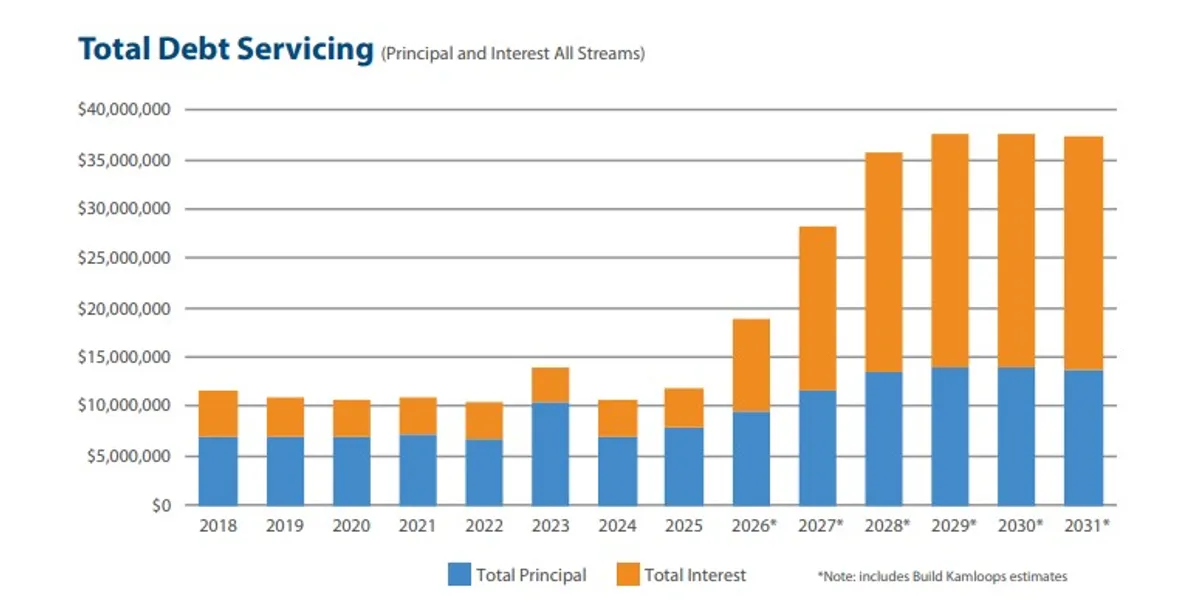
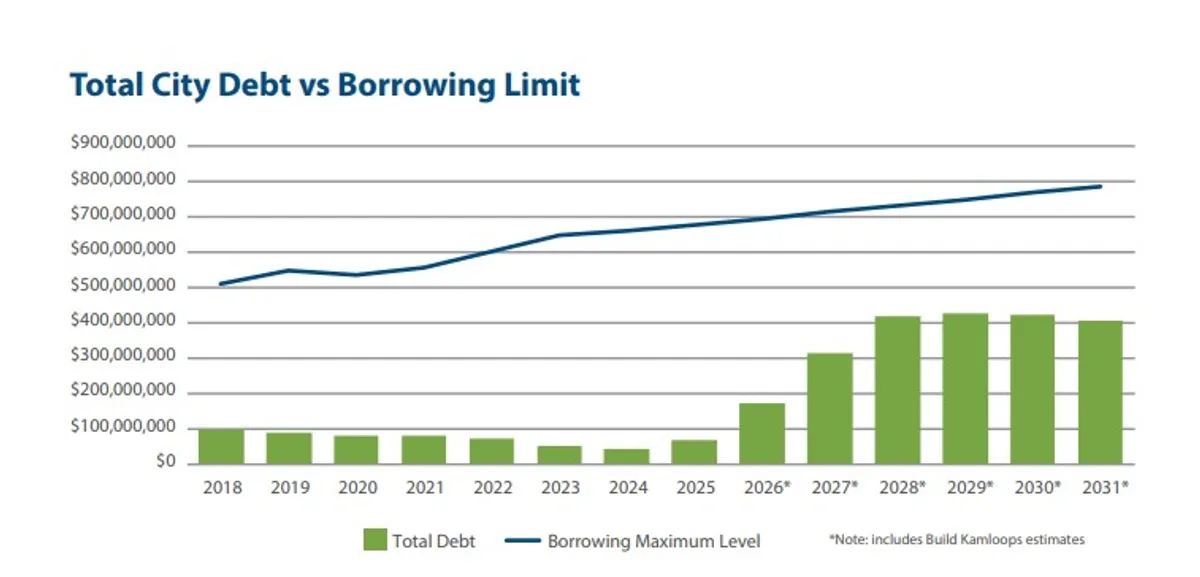
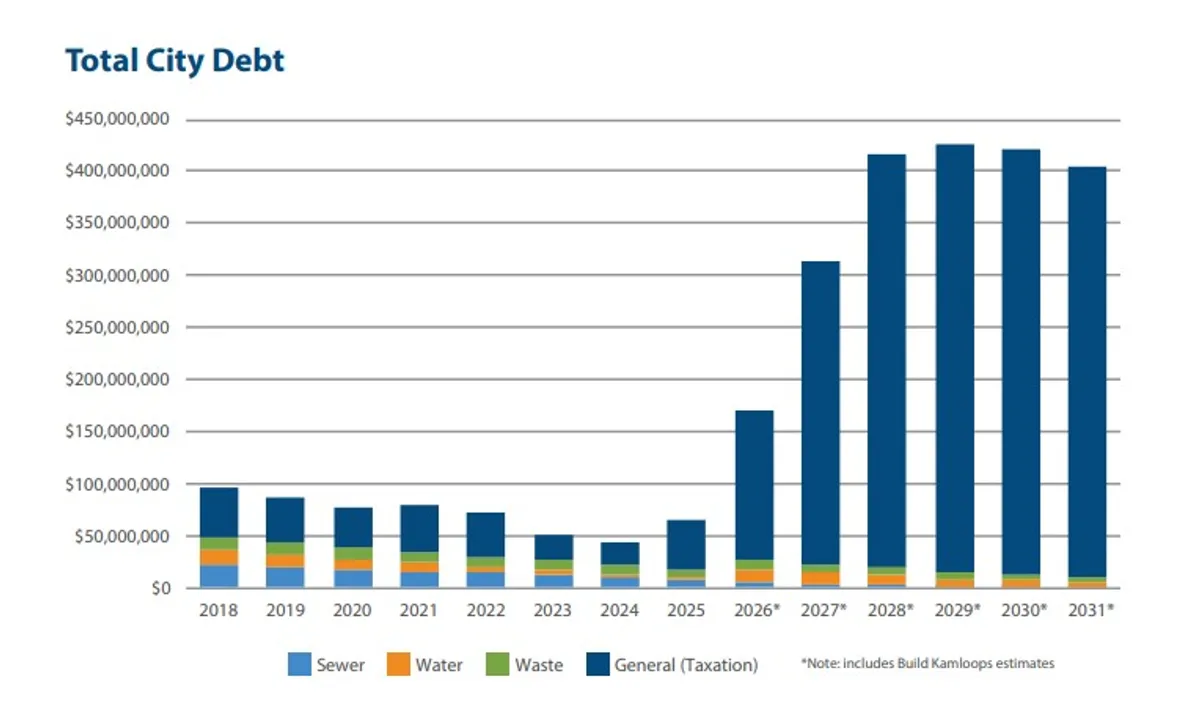
The 2025-29 Financial Plan shows that Kamloops had a total debt-load of $65.3 million at the end of 2025, up from $43.3 million at the end of 2024. Total city debt is expected to balloon to over $400-million later this decade – when Build Kamloops is factored in – with annual debt servicing payments exceeding $35-million starting in 2028.

Total City of Kamloops debt as listed in the 2025-29 Financial Plan
Total City of Kamloops debt as listed in the 2025-29 Financial Plan (Image Credit: City of Kamloops)
Total debt servicing in the City of Kamloops as listed in the 2025-29 Financial Plan
Total debt servicing in the City of Kamloops as listed in the 2025-29 Financial Plan (Image Credit: City of Kamloops)
Total debt vs borrowing limit in the City of Kamloops as listed in the 2025-29 Financial Plan
Total debt vs borrowing limit in the City of Kamloops as listed in the 2025-29 Financial Plan (Image Credit: City of Kamloops)

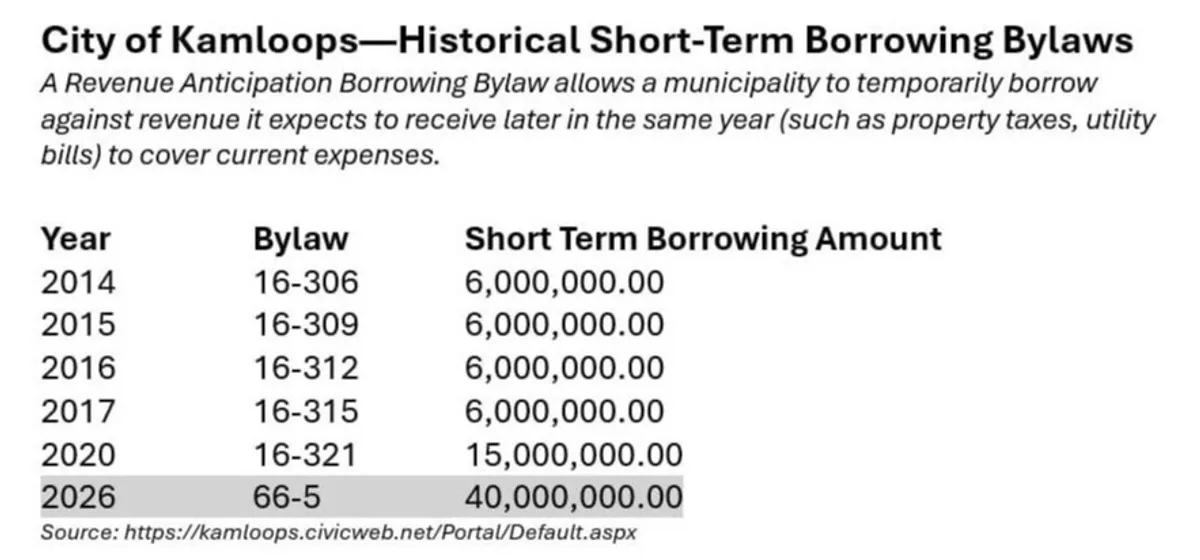
This is not the first time that Kamloops council has been asked to approve a revenue anticipation borrowing bylaw. It is the first time for this current council as the previous revenue borrowing bylaw in 2020 was used to protect the city’s cash flow from potential impacts brought about by COVID-19.

Overview of recent short-term revenue anticipation borrowing in the City of Kamloops.
Overview of recent short-term revenue anticipation borrowing in the City of Kamloops. (Image Credit: Kamloops Citizens United/Facebook with data verified by CFJC Today)

According to the city, nearly two-thirds (59 per cent) of its annual revenue comes from taxation.