
A rendering of the proposed 54-unit affordable housing development at Leigh and Fortune in Kamloops. (Image Credit: City of Kamloops / Tengri Architecture)
Low-Barrier Vs. Recovery Focused Housing

‘Egregious affront to communities’: NSBIA calls out Province’s shift away from Recovery-Oriented Housing

Dec 12, 2025 | 4:11 PM

KAMLOOPS — The North Shore Business Improvement Association (NSBIA) in Kamloops is joining the chorus of local voices speaking out against the Ministry of Housing’s shift away from a Recovery-Oriented Housing System.


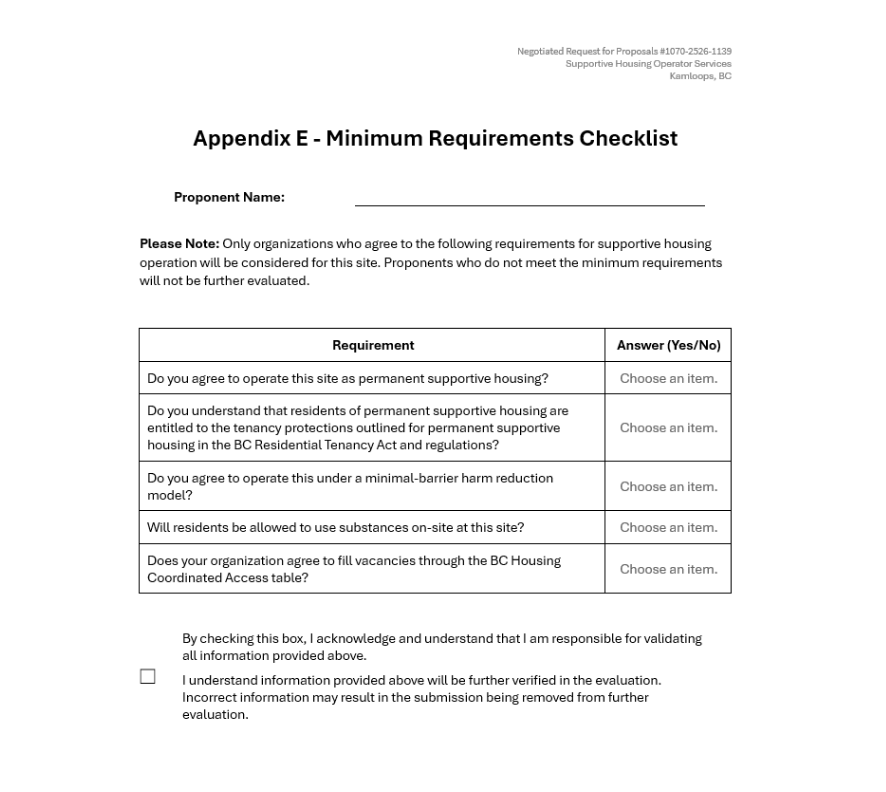
Critics say the implementation of BC Housing’s Appendix E – or Minimum Requirements Checklist – in RFP processes across the province has prioritized low-barrier housing over recovery-focused facilities.

The issue came to a head over the proposed BC Housing project at the corner of Fortune Drive and Leigh Road, where Ask Wellness’ proposal to operate a dry, recovery-focused facility was turned down by the ministry.

NSBIA Executive Director Jeremy Heighton told CFJC they’ve written to the Premier as well as the four cabinet ministers – Health, Housing and Municipal Affairs, Public Safety and the Attorney General – to voice their opposition to the new regulations.

“There needs to be a spectrum of housing across the province of British Columbia, and what we’ve seen is this sort of entrenchment of low-barrier housing across the province,” Heighton said. “What we are also however seeing is municipalities and agency leaders saying we need to change the model.”

“If we only have one type of housing, people are entrenched in that type of housing.”

Appendix E, agencies must agree to all requirements to progress through the RFP
Appendix E, agencies must agree to all requirements to progress through the RFP (Image Credit: NSBIA)

The checklist was a late addition to the RFP process for the proposed project at Leigh and Fortune, which has been in the works for over a year. It caused a proposal for a recovery-focused facility run by ASK Wellness to fail, as the requirements require operators to allow open drug use in supportive housing facilities.

“So if everybody is down at the bottom of the paradigm and there is some people at the top, what is between them?” Heighton added. “We need recovery housing that covers the full spectrum, not just warehouses people in open drug use and addiction.”

Currently in Kamloops 15 per cent of the housing units are recovery-focused. 

In an interview with CFJC, B.C. Housing Minister Christine Boyle was asked directly how the new checklist will be implemented at projected in Kamloops and across the province. She said her focus is squarely on low-barrier housing.

“It’s really about what the data shows us is needed,” Boyle said. “We know that there is a range of needs and that we are most successful when we have opportunities for people to first come indoors into a low-barrier option and start to rebuild some trust and relationships with healthcare providers.”

In the letter sent to Victoria on Friday (Dec. 12), a copy of which was provided to local media, the NSBIA also highlighted its concerns with the Residential Tenancy Act, and the struggles to evict people from low-barrier facilities.

“The challenge is when you embed the Residential Tenancy Act in low-barrier housing you have no control over whether somebody adheres to the programing or follows the recovery pathways because now if there is an issue that goes on in that housing – and we’ve seen it here in Kamloops – it can take nine, 12 or 15 months to get that individual out of that unit and put somebody in there that actually wants to try for the next pathway,” highlighted Heighton.

Heighton also noted the NSBIA – which has reached out to the province on other issues – has yet to receive a formal response from government.

“We’ve been doing this for eight years,” he said. “We’ve been advocating for a change in the mental health system, in the community engagement system, in the street management system, in the housing paradigm for eight years.”

“This is an egregious affront to communities that have been working so hard to get things done.”