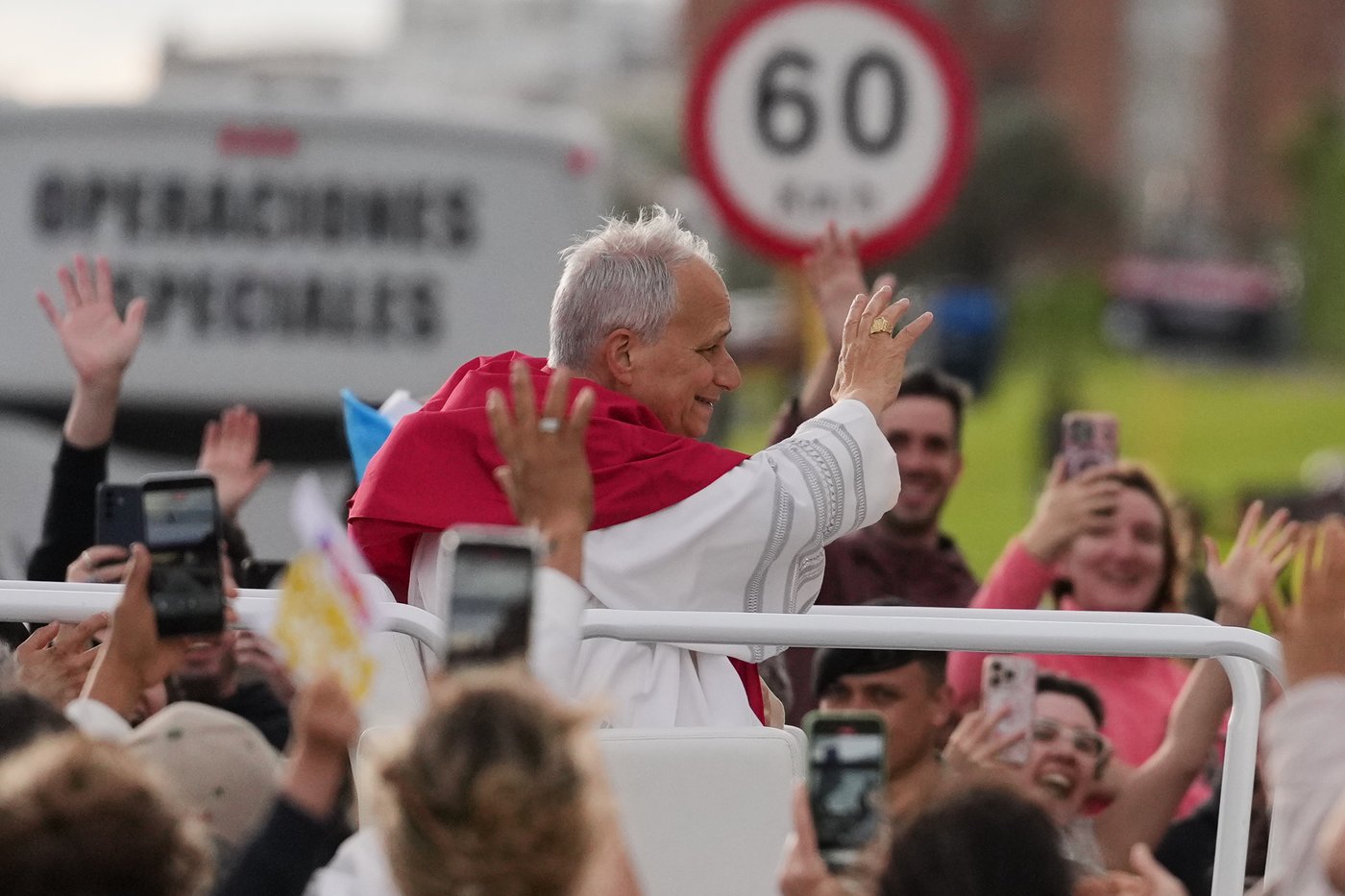
Pope Leo XIV waves after arriving in Montevideo, Uruguay, Friday, Nov. 6, 2026. (AP Photo/Natacha Pisarenko)

Pope Leo XIV arrives in Uruguay at start of South American tour less than a month after lung surgery

Nov 6, 2026 | 12:35 PM

MONTEVIDEO, Uruguay (AP) — Three weeks after lung cancer surgery, Pope Leo XIV opened a three-nation tour of Latin America on Friday by declaring he felt better than he looked and crediting God, good doctors and his healthy lifestyle with his quick recovery.

The 71-year-old pope arrived in Montevideo, Uruguay, Latin America’s most secular country, after a 13 1/2-hour flight from Rome during which he acknowledged “some people” had doubted whether he could make the gruelling, 12-day trip at all.

“I confess that from the first day, I had no doubt and was convinced that this trip had to go forward,” he told reporters aboard the papal plane.

As if to prove his point, he immediately got down to business, drawing huge crowds in Montevideo as he pulled into town in his open-sided popemobile. The Vatican estimated 30,000 people had turned out to watch him go by and attend his first event in town.

Despite the long trip, the 71-year-old Leo seemed in fine form as he arrived at the Plaza Independencia for the formal welcome and speech, held outdoors on a windy afternoon. He greeted Uruguayan President Yamandú Orsi and government officials, smiling broadly as the wind whipped the Uruguayan and Holy See flags behind him.

In his remarks to Orsi, delivered in Spanish, Leo praised Uruguay’s development but gently recalled its Catholic heritage in a bid to try to propose the Catholic faith to the country’s 3.5 million people to confront today’s challenges, a key aim of his three-day visit.

He insisted that the state was obliged to care for its people, young and old, a veiled reference to Uruguay’s permissive abortion policies and 2025 legalization of assisted dying, both of which run counter to Catholic teaching.

“It is everyone’s responsibility to ensure that each person can live with dignity, receive the care they need, and be accompanied until the natural end of his or her life,” Leo said, using Vatican terminology to articulate the church’s opposition to euthanasia.

A country with deep secular roots

Latin America is home to around 40% of the world’s 1.4 billion Catholics, but Uruguay is considered its most secular country. Here, only a fraction of people who identify as Catholic actually go to Mass regularly.

Uruguay’s secularism has roots in the weakness of its colonial church. With no gold or silver to mine, Spain valued the land of cattle ranches mainly as a buffer against Portuguese Brazil and left it largely unsettled. Montevideo was founded only in the 1720s, roughly two centuries after Mexico City and Lima.

With few priests and no local bishop, the church never became the powerful institution it was elsewhere in the empire. “Uruguay was colonized late, and that made Catholicism weaker,” said Gerardo Caetano, a Uruguayan historian.

The origins of the separation between Church and State can be traced back to the 19th century, particularly to the spread of liberal ideas promoted by European intellectuals, who viewed religion as a symptom of backwardness or a lack of rationality, said Luis Bahamondes, a professor at the Center for Judaic Studies at the University of Chile.

This process went so far as to include the renaming of certain holidays to reflect their secular character—such as “Family Day” and “Tourism Week”—signaling that the “inherent weight of Catholicism had no place within the State’s official framework,” Bahamondes added.

Since then, Uruguay has become the first country in the world to legalize marijuana for recreational use, the second country in Latin America to decriminalize abortion, and the third country in the Americas to legalize same-sex marriage.

More recently, it became the first country in the region to approve assisted dying legislation over the strong opposition of the Catholic Church.

“We still don’t understand why he chose Uruguay, given that it’s a secular country, but we hope he leaves something positive behind,” said Mary Fernández while drinking a mate – Uruguay’s beloved beverage – by the river as she waited for Leo to arrive.

By the time he actually did pull into town, throngs of Uruguayans had lined his motorcade route, cheering wildly as he passed by in his popemobile.

“I am very happy, and I am certain that his visit will bring us much good fortune and many blessings,” said retiree Marie Hernández, a 75-year-old Catholic. “We are a secular country, and it is truly beautiful to see the unity among all religions, whether Catholic or otherwise.”

Leo said the Catholic Church in particular was committed to caring for all those in need.

“To this common effort, the church contributes what is unique to her: a hope that does not fade when human resources reach their limits and which reminds those undergoing trials that their lives always retain meaning and value, that they are not alone, and that even in dark times they do not cease to be loved by God,” he said.

Questions about his health dominate flight comments

The trip to Latin America marks the longest and farthest of Leo’s pontificate, all being undertaken as the 71-year-old pope continues his recovery from Oct. 13 surgery to remove a cancerous tumor from his right lung.

Leo told reporters travelling to Uruguay he was “very happy to be here myself” and gave thanks that he was able to make the trip. After Uruguay, Leo heads to Argentina and finally Peru, where he spent two decades as a missionary bishop.

Leo credited his rebound to “Trusting God, good doctors, good surgeons, and overall I think a healthy lifestyle.”

Asked if he felt as good as he looked, he quipped: “Maybe better.”

Uruguayan church officials have marvelled at the enthusiasm the visit has provoked among the faithful, especially after Leo’s hospitalization, with reports that tickets to Leo’s prayer vigil at Montevideo’s Centenario Stadium were snapped up after two days.

“It seems that the pope’s presence is shifting something here and is gradually breaking down this veil that has always sought to obscure and diminish the presence of the Catholic tradition that lies at the country’s foundation,” said Guzmán Carriquiry, the Uruguayan former head of the Vatican’s pontifical commission for Latin America.

Andrew Chesnut, chair of Catholic studies and an expert in the Latin American church at Virginia Commonwealth University, said he wasn’t surprised that Leo’s visit had generated enthusiasm and that he would be welcomed warmly.

“But that’s not necessarily going to translate into folks in the pews,” he said. “If the overarching goal is trying to revitalize Catholicism in the most Catholic region on Earth, Uruguay is kind of a lost cause, and it has been for decades.”

___

AP reporter Ramiro Barreiro contributed from Montevideo, Uruguay.

___

Associated Press religion coverage receives support through the AP’s collaboration with The Conversation US, with funding from Lilly Endowment Inc. The AP is solely responsible for this content.

___

This story corrects a previous headline to note that Pope Leo’s visit to Latin America is a 3-nation tour, not a 3-day tour.

Nicole Winfield, Nayara Batschke And Isabel Debre, The Associated Press