File photo. (Image Credit: CFJC Today)
Waste Management

Mission Flats Landfill’s expected lifespan extended following Tk’emlups landfill’s opening: memo

Jun 8, 2026 | 9:05 AM

KAMLOOPS — A pair of waste management facilities in Kamloops have seen their expected lifespans extend by decades. 

According to a memo being presented to Kamloops council on Tuesday (June 9), the Mission Flats Landfill’s remaining lifespan has extended from 38 years to 62 while the Kamloops Resource Recovery Centre’s (KRRC), the former Owl Road landfill that now primarily handles construction industry waste, has extended from 43 years to 75.

The City of Kamloops says the extended lifespans are credited to the Stswékstem Engineered Waste Management Facility on Tkemlúps te Secwépemc. Since the Tk’emlups landfill’s opening in 2023, the city says both the Mission Flats Landfill and the KRRC have seen significant reductions in the amount of waste landfilled each year. 

Part of the waste reduction includes nearly 9,000 tonnes of waste that the Thompson-Nicola Regional District (TNRD) used to dispose of at the Mission Flats Landfill, which accounted for nearly 15 per cent of the material the west Kamloops facility would receive annually.

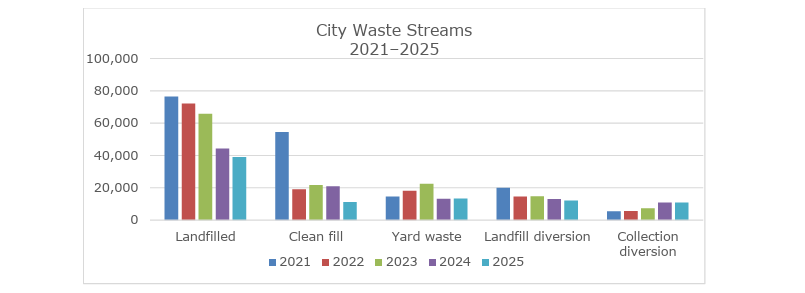
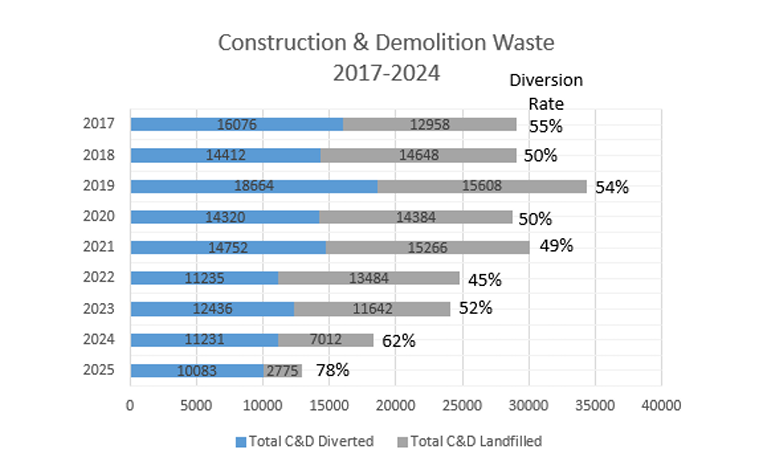
The city also noted a five-year decline in waste and construction and demolition material being sent to the landfill from 2021 to 2025, including a greater diversion rate for the latter.


(Image Credit: City of Kamloops)

(Image Credit: City of Kamloops)

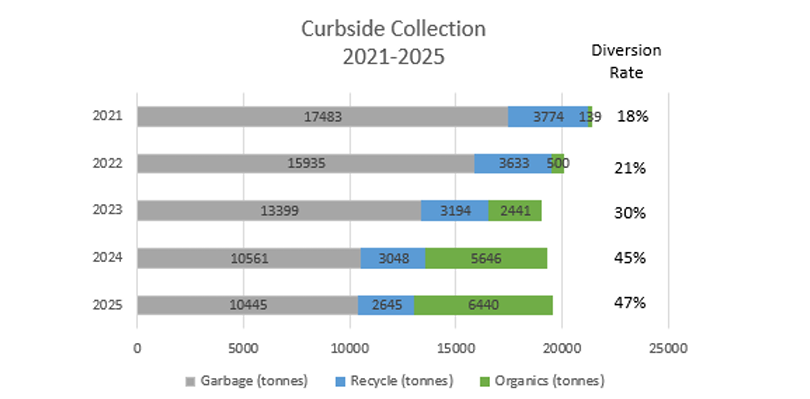
Kamloops residents have also done their part to ensure their recycling and organics material avoid the landfill. The city says the diversion rate from curbside collection in Kamloops grew from nearly 18 per cent in 2021 to 47 per cent in 2025. The city says the beginning of curbside organics collection in 2023 resulted in a substantial increase in diverted tonnage.


(Image Credit: City of Kamloops)

However, the city notes there is work to do when it comes to reducing waste disposed per person in Kamloops. 


(Image Credit: City of Kamloops)

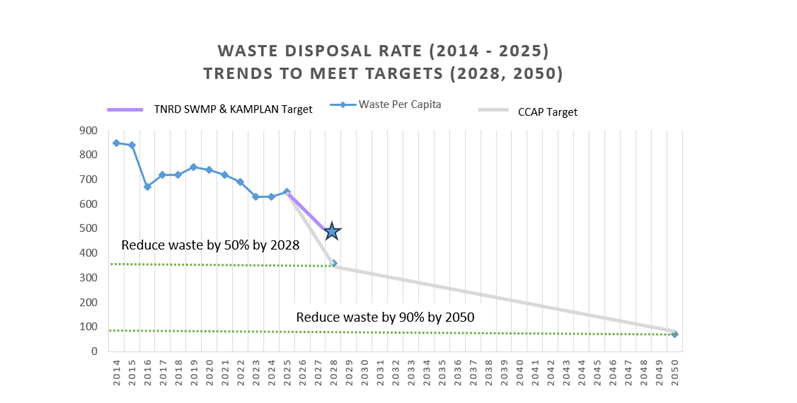
When compared to 720 kilograms per person in 2017, the city and the TNRD aim to reduce their waste disposal rate by 50 per cent by 2028 and by 90 per cent by 2050. 

According to the memo, the waste disposal rate for the city and the TNRD was at 650 kilograms per person in 2025, a decline of 11 per cent compared to 2017. Both the city and TNRD are on pace to reach 500 kilograms per person by 2028.