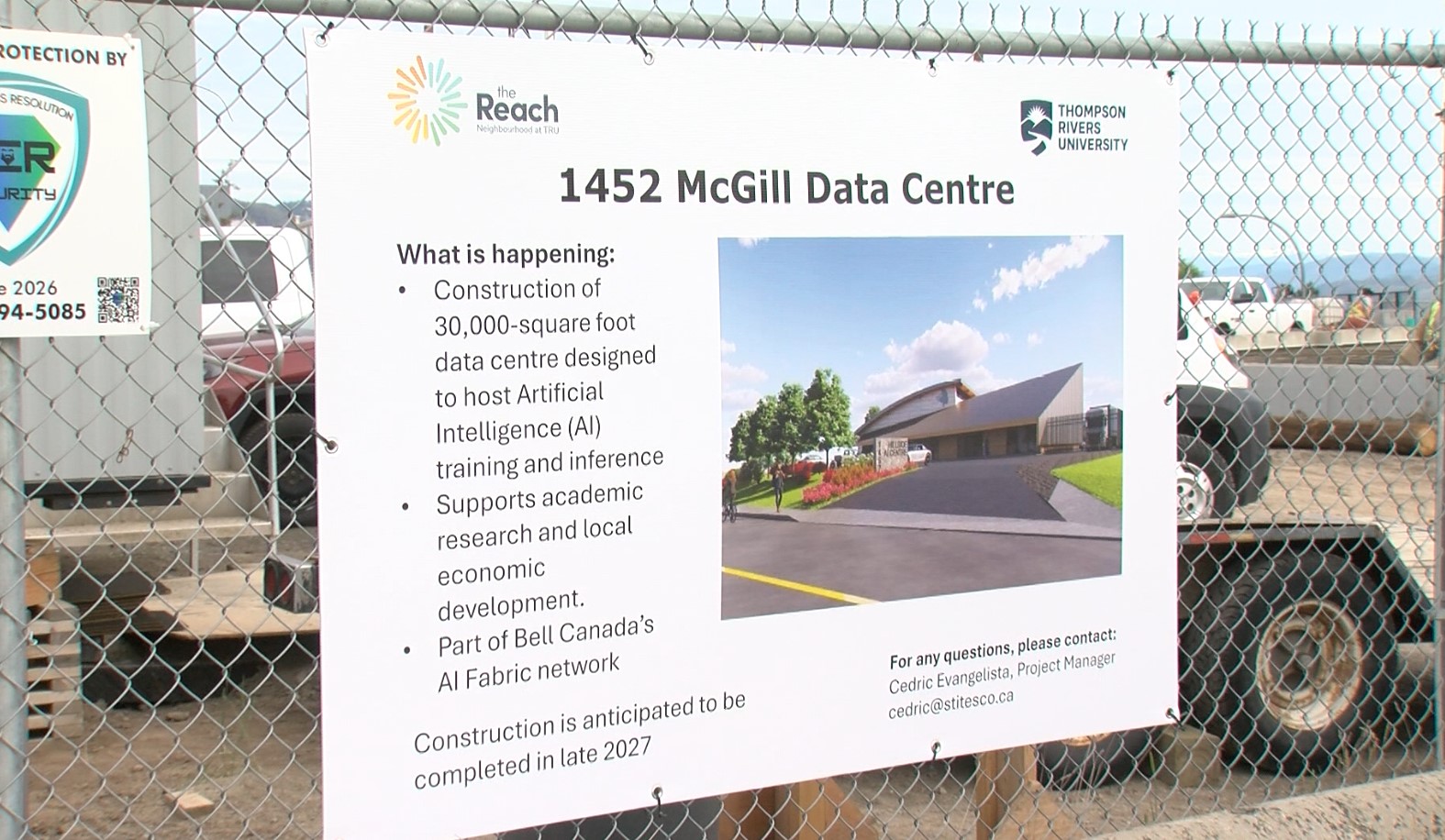
Construction on the AI data centre at Thompson Rivers University in Kamloops. (Image Credit: Kent Simmonds/CFJC Today)
TRU AI

Construction underway on new AI data centre as TRU reaffirms sustainability goals

Jun 4, 2026 | 5:05 PM

KAMLOOPS — Shovels are in the ground and work is underway on a new AI data centre at Thompson Rivers University, which is expected to be operational by next year.


The facility on McGill Road is being built in partnership with Bell and iTel Networks, and TRU president and Vice-Chancellor Airini said it helps position Kamloops at the forefront of AI innovation in Canada.

“We’re very excited that Thompson Rivers University can be at that leading edge of responsible, applied AI,” Airini told CFJC Today. “We’ve got intentions to be technology fluent as a university and we know that, in order to move forward in a good way with AI, we need to commit to responsible and applied AI.”

Construction began this spring on the data centre, which is part of Bell Canada’s Bell AI Fabric. TRU told CFJC Today the 30,000-square-foot facility is designed to provide computing capacity for AI applications and that it “does not serve as a data storage centre.”

The university noted approximately half of the computing capacity at the data centre will support academic research, while the rest will support enterprise AI services in Canada through Bell’s compute partners.

“When we refer to enterprise AI services, we are referring to computing infrastructure that supports organizations using AI technologies,” a statement from TRU said. “Artificial intelligence infrastructure is becoming as strategically important as electricity networks, telecommunications infrastructure and cloud computing.”

“Developing this capacity in Canada helps ensure Canadian researchers, businesses and public institutions can access the resources they need while supporting innovation and economic growth here at home.”

In a statement, Dan Rink, the president of Bell AI Fabric, added the project “reflects the kind of collaboration needed to strengthen Canada’s AI ecosystem.”

“By expanding domestic computing capacity through Bell AI Fabric, we’re helping ensure Canadian organizations can build and deploy AI with confidence, security and performance,” Rink, who is also founded of iTel networks, said in a statement.

Airini said the data centre will help prepare students for careers where understanding digital tools, data and artificial intelligence is increasingly important. It’ll also benefit faculty members with their research, “helping to solve challenges in the region.”

“When you tune in – as you can now – to our weekly wildfire forecasts provided by Professor [Mike] Flannigan, we’ll be able to tap into something of that capacity that’s right within the TRU grounds,” Airini said.

“[Artificial intelligence] is an effective tool for things like fire weather forecasting, fire season forecasting, fire growth modelling, fire occurrence prediction,” Flannigan added.

Flannigan said he requires a lot of data on things like the weather and fuel load from several sources in his role at TRU, noting artificial intelligence can help process all that information a lot quicker.

“For fire research, it’s a tool that we are using and exploring all sorts of new avenues,” he said. “It’s a great tool but you have to apply it appropriately.”


(Image Credit: Kent Simmonds/CFJC Today)

The facility is not without opposition, in part because of infrastructure demands and environmental impacts. The city is also cautiously ambling into the wild west of data centre regulation, as Kamloops is already home to several other data centres.

However, Airini says there are mechanisms in place to address those concerns – like using waste heat from this facility to support its climate and sustainability goals.

“The closed-loop water system matters to us,” Airini said. “All of the environmental sustainability build that’s factored into it matters to us, because we’re on track as a university to be carbon neutral by the end of this year.”

“We’ve been on a 15-year journey with the sustainability piece and caring for our planet showing that it’s possible to be a fully functioning, dual-sector research university and be operating in a good way with the planet.”

Airini also said there are checks and balances to ensure that the operators of the data centre continue to live up to their commitments once the facility is operational.

“We feel privileged that we have an opportunity to host the centre that’s going to benefit, yes TRU, but more widely, our city and our region by having this form of sustainable AI network infrastructure right on our doorstep,” Airini said.

“It positions Kamloops as something of a regional and a national leader.”