(Image Credit: Kent Simmonds/CFJC Today)
Slow Down, Move Over

‘Central B.C. has what appears to be a problem’; Hundreds ticketed for failing to slow down and move over

May 11, 2026 | 5:14 PM

KAMLOOPS — Police in British Columbia say nearly 1,000 drivers across the province didn’t slow down or move over for emergency responders and construction workers last month, and a large number of them were across the Kamloops area.


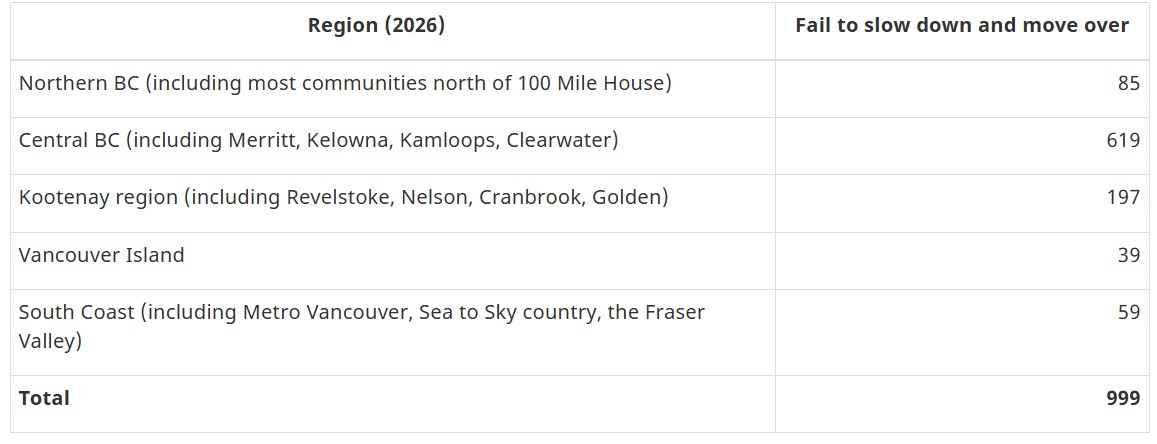
BC Highway Patrol (BCHP) has released results from the first-ever province-wide ‘Slow Down and Move Over’ campaign which ran in April. Across B.C., BCHP officers wrote 999 tickets, and 619 of those were in Central B.C., which includes Kamloops, Merritt, Clearwater and Kelowna.

“While we don’t want to read too much into those numbers, although they are significant, Central B.C. definitely has what appears to be a problem with failing to slow down, move over,” BC Highway patrol spokesperson Cpl. Michael McLaughlin told CFJC Today.

McLaughlin says the Slow Down and Move Over campaign promotes a law that was last updated in over a decade ago in 2015. BC Highway Patrol has done its own enforcement “mini campaigns” in the past, but this year, there was a concerted effort across jurisdictions.

“As police agencies, we’ve decided it’s really time we get unified and get this message out about the law to make our highways safer, and if necessary, write these tickets,” McLaughlin added. “It’s a fairly recent law, although we’ve recognized this danger for a long time.”

Last month, BCHP officers also wrote 197 tickets to drivers across the Kootenays, 85 tickets to drivers in northern B.C., 59 on the south coast and 39 on Vancouver Island.

“Enforcement depends on what police officers are available and what they’re working on at a particular day and time,” McLaughlin said. “Also with Central B.C. you have these lovely wide-open spaces that we all love.”

“We also have a fair bit of highway maintenance going on, so there is that opportunity to break the law.”

Breakdown of tickets written by BC Highway Patrol officers to drivers who failed to slow down and move over in April 2026.
Breakdown of tickets written by BC Highway Patrol officers to drivers who failed to slow down and move over in April 2026. (Image Credit: BC Highway Patrol)

McLaughlin said police plan to designate April each year as Slow Down and Move Over Month, similar to other monthly enforcement campaigns that focus on things like distracted driving and seatbelt use along with impaired driving.

That decision is welcome news to Don’s Towing in Kamloops, as their drivers have had far too many close calls while on the job.

“A lot of times when people see the yellow lights, they don’t always move over,” Josh Phillips, a manager at Don’s Towing, said. “When it’s red and blue, people slow down and move over, but for us with just ambers, it doesn’t seem to always work.”

Phillips said regular enforcement in April – and possibly around the year – is also expected to help drivers remember to slow down and move over when they come across people working on the sides of roads. 

“If you were to get pulled over and get the ticket, you’re probably going to go out and complain to your friends about it, so more people hear it that way,” Phillips said. “Whereas if no one is getting an actual fine or anything, they’ll just keep quiet.”

On roads and highways with speeds above 80 km/h, the law says drivers have to slow down to at least 70 km/h and move over as far away as safely possible. When the speed limit is below 80 km/h – as is common on city streets – drivers must slow down to 40 km/h.

The fines for failing to slow down or move over starts at $173. Depending on the violation, people can also be charged for driving without due care and attention, which carries a fine of $368.

“We are sensible people and we try to apply the most sensible fine,” McLaughlin said. “We recognize when people are doing their best to obey the law, and they’re obeying the spirit as well as the letter of the law.”

“You’re not going to get a ticket if you don’t weave hopelessly into the other lane. In fact, we do not want you to do that.”

McLaughlin suggested making eye contact with people at the side of the road if possible, so they can see that drivers are trying their best to keep everyone safe.

“Keep in mind that people are out there working and they’re trying to go home to their families too,” added Phillips. “You might not see them on the side of the road but they’re probably there.”

“Slow down, move over and get out their lane if you can. It’s greatly appreciated.”