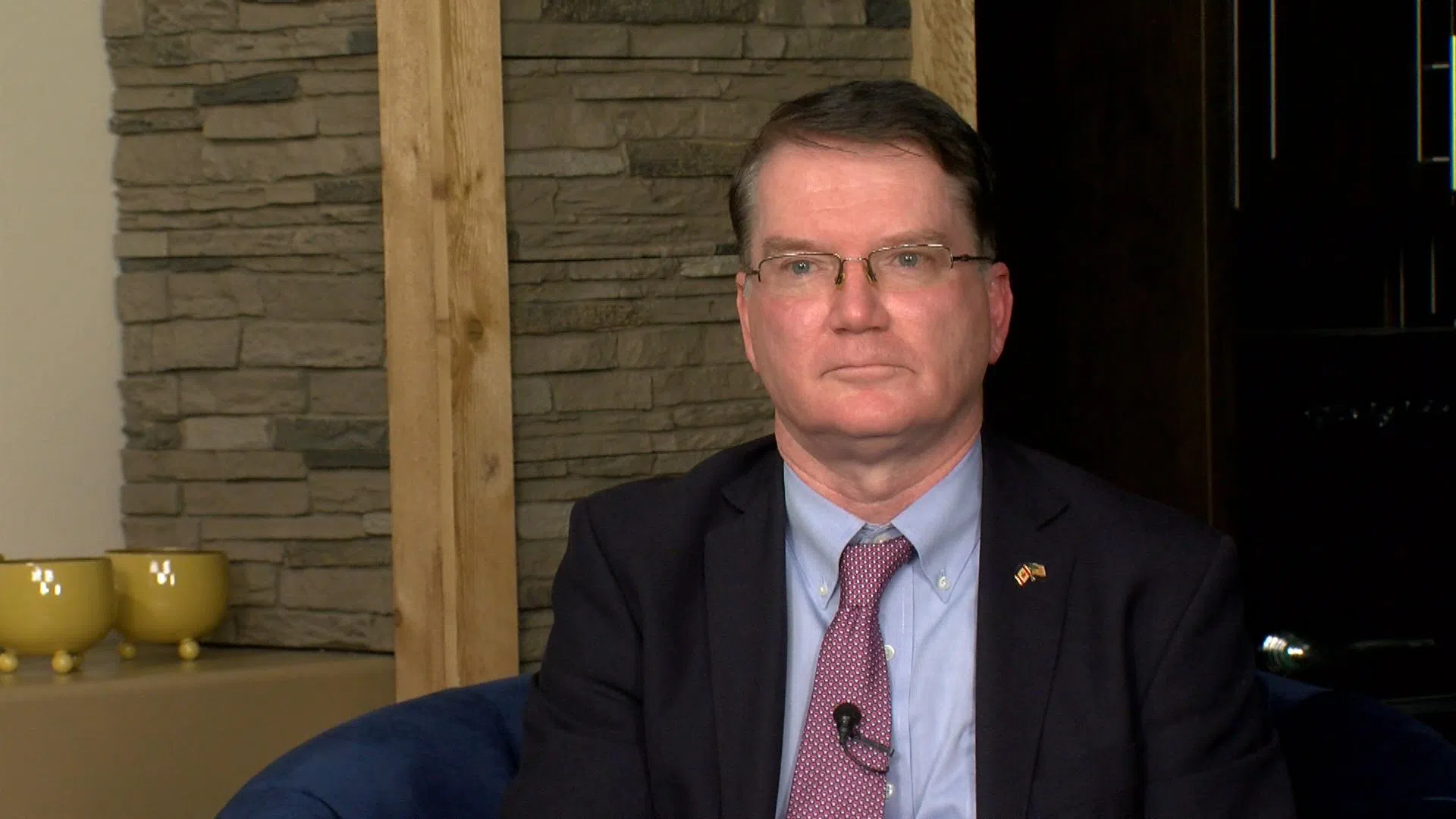
Consul General Shawn Crowley (Image Credit: CFJC Today)
USA CANADA TRADE RELATIONSHIP

In Kamloops for a rare visit, top American diplomat in B.C. discusses state of U.S.-Canada relationship

Jan 16, 2026 | 4:04 PM

KAMLOOPS — The relationship between Canada and the United States has soured over recent months, with the Trump administration picking fights around the globe with increased tariffs. While the Canada-US-Mexico Agreement (CUSMA) is set to be renegotiated later this year, Canada and the US still honour the free trade agreement that covers the vast majority of products that traverse the border.  


Washington, DC’s highest diplomat in British Columbia was in Kamloops and sat down with CFJC News to discuss about the US-Canada relationship.

Prime Minister Mark Carney and several premiers have been in China this week, securing deals on commodities like canola and lumber, helping diversify Canada’s trade. US Consul General for B.C. and the Yukon Shawn Crowley is well aware of the strained relationship with the United States and how it may be pushing Canada closer to one of the US’s largest adversaries.  

“We fully understand that Canada is looking to diversify it’s markets. I think right now over 75 per cent of Canada’s exports go to one country, so it’s logical that you would do that,” Crowley told CFJC News. “In the United States, we are doing the same thing. We are also looking at China and we do a lot of business with China we are trying to figure out how we can diversify some of that trade.”

CUSMA is up for renegotiation this year. While the previous edition was signed and negotiated by President Donald Trump himself, he’s recently called it ‘irrelevant’. 

“Well, I think the president was getting to the point that the US Trade Representative has also made, that is we all agreed that, after six years, we were going to review this — not just in Washington, but you are reviewing it here in Canada, as well,” said Crowley. 

“That review is very important and I think what they are focused on, is they do not believe just rubber stamping and continuing with no changes is really an option. There are other options, of course, open there. Do you do some changes? Do you get rid of the whole thing? And there is a broad spectrum of what industry feels is the appropriate thing to do,” added Crowley. 

In British Columbia, there is hope that Ottawa will push Washington on a new softwood lumber deal.

“The softwood lumber dispute, as everyone knows, has been going on since the 1980s. We have had mild success at time with mini-deals,” said Crowley. “There was talk of quotas, Minister (Ravi) Parmar and [Premier David Eby] both mentioned that, but they mentioned that a month before the countervailing duties were going to go into effect. That, of course, is not enough time. You have to do it a year ahead of time.”

“It’s also important to realize the countervailing duties, unlike some of the new tariffs that are going into effect — yes, they started after President Trump assumed office but they were completely put into place previous to that,” added Crowley.

Work on political positioning is underway ahead of the new deal with Canada, with the US ambassador saying Canada was “mean and nasty to deal with” and the US “does not need Canada,” referring to our goods and manufacturing. Crowley believes those clips don’t paint a clear picture.

“I think the ambassador explained a little bit more. Canada doesn’t need the United States, the United States doesn’t need Canada — if you stop the quote there, that sounds very bad. But what he went on to say is this is a relationship that is super important to both sides of the border. Our prosperity is more because of the work that we do together,” stated Crowley. 

“That doesn’t mean you need them but it also means, in the long term, that relationship has been beneficial to Canadians and beneficial to Americans.”

Crowley noted the current discourse and noise don’t help find a path forward.

“Even if you are wildly successful and get five per cent of our foreign trade diversified, that means you are still going to have 70 per cent of your trade with the United States,” said Crowley. “And so, while we are emotional when we are talking to each other, I think it’s important not to lose sight of the big picture because it’s really important to the livelihoods and the jobs of people on both sides of the border.”

“This is not perhaps the worst that the relationship has ever been between Canada and the United States. We go through cycles, ups and downs — it’s like family. We fight with each other and sometimes those fights seem to be even more vicious than usual because they are so important and because the interests at stake are so important,” said Crowley. 

CFJC will have more with Consul General Crowley on Monday (Jan. 19).