File Photo (Image Credit: Cliff MacArthur / BC Provincial Court)
Kamloops Land Claim

Province, Stk’emlupsemc te Secwepemc Nation mum on decade-old land claim case covering Kamloops, Sun Peaks

Nov 11, 2025 | 6:00 AM

KAMLOOPS — The B.C. Ministry of the Attorney General said the province’s ongoing position on a decade-old land claim that includes Kamloops and Sun Peaks has not changed, and that “private property rights must be upheld.”

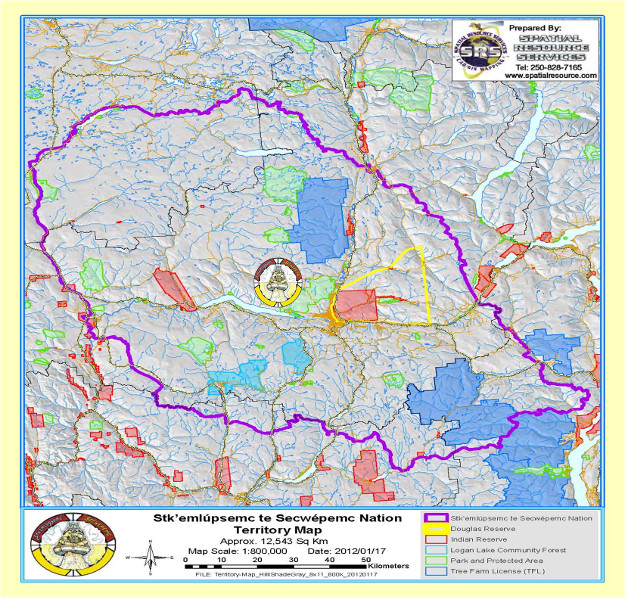
CFJC asked the ministry for comment on a 2015 claim by Stk’emlupsemc te Secwepemc Nation (SSN), which sought title over an estimated 12,543 square kilometres of their traditional territory.

SSN, which is comprised of Tk’emlúps te Secwépemc and the Skeetchestn Indian Band, claims title over Crown land, private property, railway and road infrastructure, and mineral rights.

The claim was opposed by both the provincial and federal governments after it was filed in part to prevent the establishment of the Ajax mine near Kamloops, which was subsequently rejected by both the provincial and federal government.

CFJC has also attempted to contact Tk’emlúps te Secwépemc Kúkwpi7 Rosanne Casimir to inquire about the status of the land claim but has not yet heard back.

While the SSN claim has been slowly moving through the courts, it is back in the spotlight following the recent B.C. Supreme Court ruling that granted the Cowichan Tribes (Quw’utsun Nation) fishing rights and Aboriginal title to about 300 hectares of land in Richmond.

That ruling also noted that Crown and city titles within the area “are defective and invalid” as they “unjustifiably infringe the Cowichan Nation Aboriginal title to these lands.”

The Musqueam and Tsawwassen First Nations, along with the federal and provincial governments, the City of Richmond and the Vancouver-Fraser Port Authority all opposed the Cowichan claim during the 513-day trial.

The federal and provincial governments are appealing the Cowichan ruling. The province is seeking a stay on Justice Barbara Young’s findings until the appeal can be heard.

The province had argued in B.C. Supreme Court that Aboriginal and fee-simple title cannot coexist on the same land in their full form, seeking suspension of Aboriginal title, while the City of Richmond, which was also a defendant, sought extinguishment.

Both arguments failed.

“The recent court decision is just the tip of the iceberg when it comes to claims of Aboriginal title in this province,” independent Surrey MLA Elenore Sturko said, in a statement. “The government has failed to act in its basic duty to notify British Columbians of litigation that directly impacts their rights.”

The Union of British Columbia Indian Chiefs has called that Cowichan ruling “a monumental development,” though it also said the case isn’t about threatening private home ownership.

“First Nations have long warned that if governments refused to recognize and implement Aboriginal title in a principled manner through negotiations, these questions would inevitably end up in the courts,” vice-president Chief Don Tom said.

The SSN claim was last in court in September, though the most recent response from the province was filed nine years ago.

“While the province will not comment on legal strategy in cases that are before the courts, the province’s response is consistent with the province’s ongoing position, reflected in our litigation and negotiation approaches, that private property rights must be upheld as we seek to advance reconciliation with First Nations in B.C.,” a Ministry of the Attorney General spokesperson told CFJC on Friday (Nov. 7) when asked if that position has changed.

“Filings in this case and others are available on the Court Services Online website.”

In a statement, Kamloops-Centre MLA Peter Milobar – who was mayor of Kamloops between 2008 and 2017 – noted the province’s opposition to the SSN land claim from a decade ago.

Milobar noted current Premier David Eby was named B.C. Attorney General in 2017, and that he “needs to clarify if the government has changed [its] defence in this case or if they have continued to defend private property rights.”

Eby’s office has appointed a ‘community contact‘ to work with residents of Richmond to answer questions and listen to residents’ concerns and experiences following the Cowichan ruling.

The Tŝilhqot’in National Government has called on governments to set the facts straight around Aboriginal title and to stop what it calls “fear-mongering.” The Williams Lake-based band was the first in Canada to win a court declaration of Aboriginal title in 2014.

“The Tŝilhqot’in Nation, with a court declaration of Aboriginal title, has never targeted private property and has no intention of doing so. Private lands were excluded from the declaration of title,” the Tŝilhqot’in Nation said in a Nov. 6 statement.

The Cowichan Tribes shared a similar statement on Oct. 27, which said its court case regarding the settlement lands in Richmond “has not and does not challenge the effectiveness or validity of any title held by individual private landowners.”

“The ruling does not erase private property,” the Cowichan statement added.

However, Tom Isaac with Cassels Aboriginal Law says private property owners in B.C. should be concerned about the Cowichan land title court ruling.

“A precedent that will flow from this case is that sections 23 and 25 of the Land Title Act do not apply to Aboriginal title,” Isaac, a leading expert on Aboriginal law told Global News.

“Those are not my words — those are the judge’s words, paragraph 3,551. So anyone suggesting this is about 800 acres, it’s simply not the full story on the decision.”

In a separate ruling in September, the B.C. Supreme Court upheld the Haida Nation’s Aboriginal title over the Haida Gwaii archipelago. It affirmed a deal between the First Nation and the province that would allow Aboriginal and private property rights to coexist.

“So [the province is] in one court saying private property and Aboriginal title cannot coexist and in a different court saying private property and Aboriginal title can coexist,” Caroline Elliott, the director of the Public Land Use Society, told Global News.

“So there’s a reason for people to be confused and frustrated and angry about this.”

Added Issac, who one of the top legal minds in Canada on Aboriginal law, “this issue requires very prudent, thoughtful, serious, public government leadership.”

– with files from The Canadian Press and Global BC