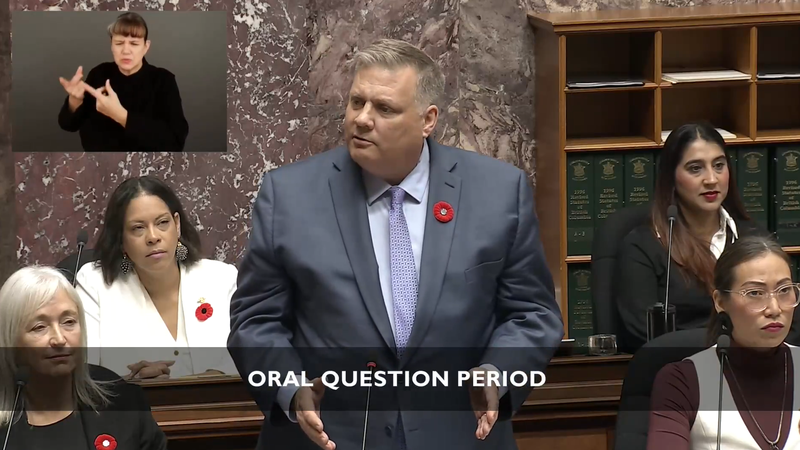
Kamloops MLA Peter Milobar speaks during question period on Oct. 30, 2025. (Screengrab via BC Legislature)
Pipeline Values

Kamloops MLA tables legislation to ‘draw attention’ to proposed changes to pipeline assessments

Oct 30, 2025 | 4:12 PM

KAMLOOPS — A Kamloops MLA has introduced legislation to draw attention to “the latest NDP backroom deal” that his party says will shift hundreds of thousands of dollars in taxes onto homeowners and small businesses, while giving multimillion-dollar property tax breaks to billion-dollar pipeline companies.

BC Conservative MLA Peter Milobar says the Municipal Affairs Statutes Amendment Act of 2025 will update existing rules on rate caps and allow municipalities to “accommodate revenue changes if the NDP refuse to halt the property devaluation of pipelines.”

“[It] would enable municipalities to adjust what they collect, actually keep what they collect from pipeline utilities at the same rate that they are currently collecting,” Milobar said in the BC Legislature Thursday (Oct. 30).

“It would not add a cost to the pipeline. It would simply say that they are going to be charged the same amount of taxation they were already planning and telling communities that they were willing to pay in the first place, thus relieving pressure on heavy industry and small businesses across British Columbia by municipalities faced with hard decisions to make otherwise.”

Milobar’s legislation comes not long after the Thompson-Nicola Regional District (TNRD) raised the alarm over the proposed changes to the way gathering and transmission pipelines like Trans Mountain are assessed.

“This is the latest example of NDP backroom deals and financial mismanagement landing squarely on the backs of ordinary British Columbians,” Milobar, the Opposition Critic for Finance, said.

“This is not just a rural issue. Cities like North Vancouver, Burnaby and Kamloops already face rising costs and service pressures — now they will be forced to make up for a tax break negotiated behind closed doors with billion-dollar corporations.”

According to the TNRD, the changes – which still have to be approved by Finance Minster Brenda Bailey – will lead to a drop of around $250,000 in revenue in next year’s budget, nearly one per cent of the TNRD’s total 2025 tax requisition of $28.8 million.

TNRD Chair Barbara Roden told CFJC that the regional district will have to make up that shortfall by asking other property classes to pay more. She said in the electoral areas, the majority of that burden will fall on residential taxpayers.

“BC Assessment has decided to switch the method by which pipelines are assessed and they’re now going with a depreciation method instead of an income-based,” Roden said. “Every single local government in the province that has a pipeline is going to be affected by this and there has been no government consultation.”

Work on the proposed changes has been underway since 2016 after pipeline companies approached BC Assessment to say that the assessed values of their properties “were not representative of the current costs.”

BC Assessment told CFJC in a statement that local governments were formally notified about the proposed changes on Sept. 18 this year, and that was “in advance” of the traditional assessment preview for the next year, which happens in November.

“[We are] committed to providing advanced notice to our municipal, regional district and Indigenous partners of changes that may impact assessed values prior to the upcoming assessment notices coming this January,” BC Assessment added.

In a statement, Tony Luck, the BC Conservative Critic for Municipal Affairs and MLA for Fraser-Nicola, also took issue with the proposed changes, saying municipalities will be forced to raise taxes to replace lost revenue as they’re not allowed to run deficit budgets.

“As families and small businesses face rising taxes across every rate class, the NDP cut a backroom deal with billion-dollar pipeline companies,” Luck said. “This comes at the expense of local businesses and will impact the already-struggling forestry sector in BC.

“At a time when US tariffs and NDP ideological bureaucracy are decimating forestry, causing layoffs and unprecedented mill closures, sawmills and pulp mills are likely to be the first targets for rural municipalities under pressure to keep the lights on.”

Both Milobar and Luck want Bailey to halt any assessment changes until communities are consulted, echoing a similar sentiment that was made by the TNRD.

“I get that BC Assessment has to assess properties and update valuations on a regular basis,” Roden said. “No one is trying to argue they shouldn’t.”

“It’s just we would like more consultation and transparency as to why this is suddenly necessary, and why weren’t local governments looped in and told that this was coming?”