Four lane traffic on the Overlanders Bridge as seen on Oct. 16, 2025. (Image Credit: City of Kamloops)
No More Traffic Woes?

Four-lane traffic returns to Overlanders Bridge as City of Kamloops completes rehabilitation project

Oct 16, 2025 | 2:00 PM

KAMLOOPS — Four lanes of traffic are flowing across the Overlanders Bridge in Kamloops Thursday as the city says it has completed the latest round of rehabilitation work on the bridge deck.

The city said the work, which began in mid-July, was needed to extend the life of the 64-year-old bridge that spans the Thompson River in Kamloops. River Valley Construction Services Ltd. was picked as the contractor following an RFP process in the spring.

“All lanes on the Overlanders Bridge are now open and traffic movements are fully restored,” the City of Kamloops said in a brief statement Thursday (Oct. 16). “A big thank-you to everyone for your patience and co-operation throughout this project.”

While four-lane traffic was briefly restored earlier this month, one southbound lane on the bridge was closed for the final phase of the project which involved asphalt and membrane work on the Mission Flats/Summit Drive off-ramp.

That closure ended on Wednesday (Oct. 15) evening, though the city cautions that all of the work on the bridge has not yet been completed.

“Line painting will be completed soon, so please continue to drive with care,” the city statement added. It did not say when that line painting work is scheduled to take place.

The rehabilitation project also included the application of a sand-textured epoxy coating to the multi-use pathway on the bridge to improve safety and durability.

Project scope limited

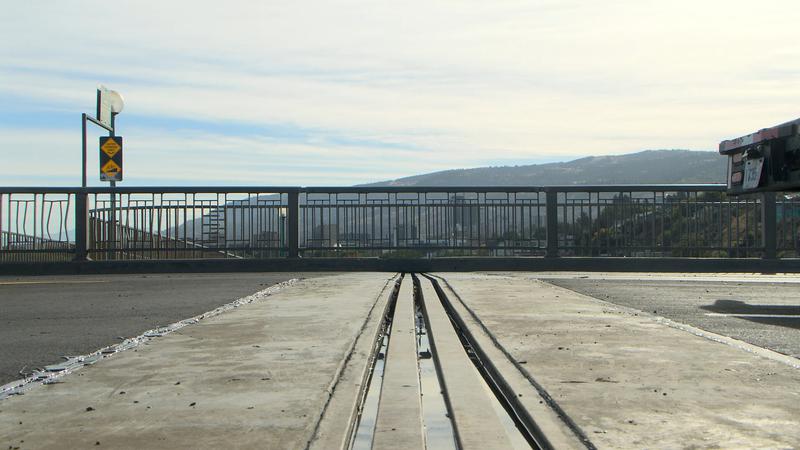
According to the City of Kamloops, the scope of the Overlanders project was limited to the expansion joints on the bridge. A number of those joints were also removed, and city staff previously said they expect the bridge surface will get smoother over time.

“The quality of the work is top notch,” Matt Kachel, the city’s infrastructure delivery divisional manager, said earlier this month. “We haven’t had to go back and do any rework, which is really good.”

An expansion joint on the Overlanders Bridge (Image credit: CFJC Today)

Kachel added there are no plans to repave the entire bridge deck as the remaining asphalt is still “in a serviceable condition.” He said removing asphalt would have also compromised the waterproofing membrane that protects the concrete and steel structure of the bridge.

“If were to remove the asphalt, we would have had to redo that membrane as well and it would have increased the cost of the project,” Kachel said.

“This is preventative maintenance in a 10-year cycle so that we don’t get drawn into a bigger project like 2015, and start having to get into deck repairs where it’s much more significant, it’s much longer.”

This year’s project took about three months to complete at a cost of around $2.2 million. The 2015 project took six months to complete at a cost of approximately $10.3 million.

“There’s nothing wrong with the rest of the membrane,” Kachel added. “[Repaving the entire bridge] would have just been more about aesthetics than anything, and we would be removing infrastructure with life left in it still.”

Overlanders repaving 7-to-10 years away

At the Oct. 9 Governance and Service Excellence Committee Meeting, Joe Luison, the City of Kamloops’ assistant civic operations director, said the bridge deck is not scheduled to be repaved for another seven-to-10 years.

“With any type of infrastructure there are maintenance points, and at this point in time, it was the joints that were failing,” Luison said. “[In the interest of] good governance and funding, we chose to do the limited work now, which would be no different than doing asphalt patches on Fortune Drive.”

Kachel also said that the next project on the Overlanders Bridge could involve the replacement of the entire protective membrane. While it could mean a lengthy project similar to 2015, he noted that planning and design work has not yet been done.

“I believe it would be joints and the areas in between,” Kachel said. “The contractor and engineers were able to get a better look at exactly what was going on this year so it helps us plan for the next project.”

More frequent maintenance

Kachel also said while doing maintenance in 10-year intervals might seem like a lot to some, it is necessary given the age of the Overlanders Bridge.

“It never anticipated having vehicles that were this heavy and this many of them so, just like tires on the car, these joints are subject to wear and tear. More vehicles, heavier — it reduces the service life of the joint,” Kachel said. “That’s why we’re on 10-year intervals.”

“The 30-year intervals were bigger projects. The 10-year ones are smaller projects that help avoid those bigger projects for longer so that we’re being good with the funds, making sure that we spend the money that we need when we need to spend it and not more.”