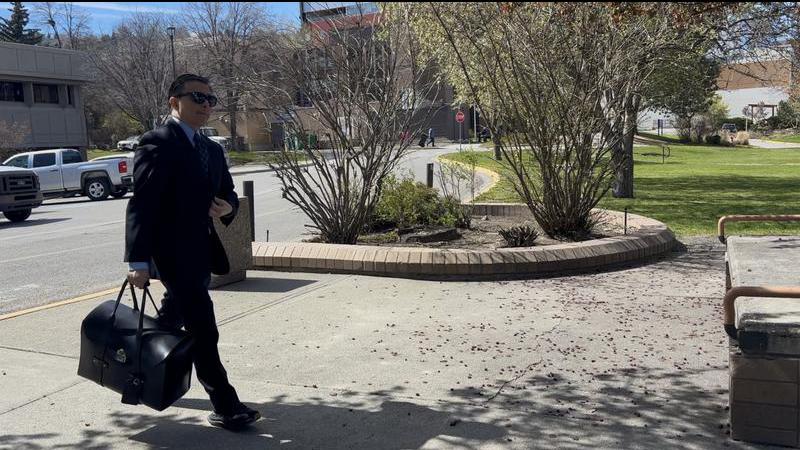
Butch Bagabuyo leaving Kamloops Law Courts on April 17, 2025. (Image Credit: CFJC Today)
FIRST-DEGREE MURDER TRIAL

Defence denies former Kamloops lawyer’s killing of client was planned; claims manslaughter

Oct 8, 2025 | 4:33 PM

VANCOUVER — Rogelio ‘Butch’ Bagabuyo, a former Kamloops lawyer in court for trial on a first-degree murder charge, says he did kill his client, but his legal team claims Mohd Abdullah’s death wasn’t the intended outcome that day.

Defence closing arguments opened Wednesday’s (Oct. 8) proceedings out of BC Supreme Court in Vancouver. It comes after two days of closing submissions from Crown counsel, which outlined several actions Bagabuyo took that prosecutors described as a clear indication the killing had been planned ahead of time, and was done to escape the consequences of the financial and legal fraud Bagabuyo had committed.

Bagabuyo’s lawyer, Mark Swartz, says Bagabuyo concedes he is guilty of manslaughter and the deceased client was ‘well aware’ of the unlawful financial scheme they’d undertaken. The bulk of defence arguments were focused on poking holes in the Crown’s submission that the killing was a planned murder.

Swartz cites the start of it all dates back to January 2016, when Abdullah contacted Bagabuyo about retaining him for his divorce proceedings. Shortly after this, they met and Swartz described that meeting as the genesis where the two men agreed to conceal Abdullah’s funds from his then-wife.

“They both made a decision to do something that, if the authorities found out, would lead to significant trouble for both of them,” stressed Swartz. “Jeopardy in their professional careers and, more significantly than that, criminal jeopardy.”

The bulk of Swartz’s argument painted Bagabuyo as ‘effectively living paycheque-to-paycheque’ and noted Bagabuyo hadn’t been earning a significant income from his law practice when Abdullah approached him. He described Abdullah as Bagabuyo’s ‘golden goose’, from a financial sense — though it’s unclear who was first to bring up the idea to hide Abdullah’s savings.

Swartz admitted the forensic accounting evidence showed the money was very quickly spent by Bagabuyo, and described the excuses curated by Bagabuyo to delay returning the money to Abdullah as ‘crafty’. Eventually, Abdullah’s patience wore thin, according to defence, and his stress around wanting the money back grew.

“Now, in terms of the consequences of this scheme, Mr. Abdullah is well aware of the implications. He’s told Ms. Milanese (a close friend of Abdullah’s who testified previously) what he and his lawyer have done, and if anyone finds out, he’s going to jail.”

Swartz referenced a November 2021 conversation between the two men that Abdullah had recorded, which was played out as evidence in court earlier in the trial. Abdullah can be heard describing the stress he’s under with not receiving his money back and repeatedly pleads with Bagabuyo to resolve it.

“That audio displays (Abdullah’s) frustration, his anguish, his upset and anger with respect to the fact that those monies are not being returned back to him. He can’t keep calm and collected in that situation despite knowing he is recording himself. Mr. Bagabuyo is, on the other hand, I would suggest, completely calm and collected,” said Swartz.

Defence submits at that point, both men knew they had no legal recourse. Abdullah couldn’t risk suing Bagabuyo over the money without his own illegal activity coming to light, and any action taken by Bagabuyo would put him in a criminal bind, as well.

At the March 11 meeting downtown, the defence lawyer admitted it’s not known what exactly transpired, but it can be inferred that Bagabuyo finally revealed to Abdullah the money was ‘long gone’.

Swartz submitted Abdullah was significantly agitated and “it’s not unreasonable that at that stage, he began to physically attack Mr. Bagabuyo.” Swartz repeatedly mentioned the notion that Abdullah’s rage would’ve been fueled by the realization that his life savings were gone.

He theorized it’s not clear who had the knife first or where it was grabbed from, but Abdullah wound up dead, and Bagabuyo made a panicked decision not to call the police because he knew the fraudulent scheme would be uncovered.

Swartz acknowledged right from the start of Wednesday’s proceedings that a self-defence argument would require more evidence and much of the evidence shared by the Crown was not contested. It was plainly stated a number of times that Abdullah ends up dead after he was repeatedly stabbed.

“Of course, we don’t know the context of which that occurred, other than there was a meeting at the office and Mr. Abdullah ends up being stabbed a number of times. But surrounding circumstances as to how that unfolded, we’ll never know,” Swartz noted.

Earlier in the trial, Bagabuyo opted not to call any evidence, after he’d originally been scheduled to testify on his own behalf. Swartz said after Abdullah was dead, Bagabuyo was left to deal with the body and wound up using the tote that had been purchased to store files at the office, a task he says Bagabuyo had “procrastinated on.”

As for the items purchased ahead of time that the Crown had submitted as proof of Bagabuyo’s planning for the murder, Swartz characterized most of those purchases as being in line with Bagabuyo’s ‘hoarding’ tendencies and impulsive shopping. He noted Bagabuyo’s home already had a noticeable amount of ratchet straps, nitrile gloves, several propane tanks and a hacksaw, while Bagabuyo’s vehicle already had napkins, paper towel, gloves and masks inside.

Swartz says it is the defence’s view that there are flaws in the Crown’s claim that Bagabuyo undertook calculated planning for his client’s murder. Swartz jokingly described the Crown’s submission of how the area was intentionally set up with poly-sheeting for apparent murder as reminiscent of a common serial killer plotline of the TV show Dexter.

Instead, Swartz noted the way the poly sheeting wasn’t laid out with where the biggest mess from a planned killing would be, adding that the office space wasn’t a private location that would ordinarily be chosen for a planned murder. He pointed out Bagabuyo’s legal practice was in a shared office building with other businesses and was also under renovation, which presents a risk of contractors coming in and out of the space. Swartz went on to describe how a lack of parking availability wouldn’t make his office a prime location, not to mention the inconvenience of taking a body down a flight of stairs and out on to a busy street.

All these factors are part of the defence argument that Bagabuyo couldn’t have planned the murder in advance and instead, made panicked decisions to conceal the killing after the fact.

It’s the defence’s position that the index card found in Bagabuyo’s home reading ‘Bag everything after. Don’t bring phone, e-watch. Turn apps off, location services.’ wasn’t a pre-murder checklist and was a rushed reminder written after the killing.

With regards to the steel drums that had been purchased, Swartz says there is no evidence as to when those drums actually arrived at Bagabuyo’s property and there’s no evidence that anything was done with either of the steel drums, despite potentially having Abdullah’s body at his property for four days.

“The fact that nothing has been done in a period of four days suggests there was no plan,” theorized Bagabuyo’s lawyer, “that this is all unexpected and he’s still trying to figure out, ‘What am I going to do with this body?'”

Swartz said the move to involve Wynand Rautenbach to rent and drive a van to help Bagabuyo hide the tote bin ‘makes no sense’. He went on to cite Rautenbach’s grandson’s description of his grandfather’s driving becoming a concern and theorized that their ‘aimless driving’ in search of a place to bury the bin doesn’t appear to be well thought out.

By the late afternoon of Wednesday’s session, Swartz addressed the garrote device found amongst the evidence, which was previously identified as some kind of homemade ligature. The device was found around Abdullah’s neck and appeared to have been put there after the body was wrapped in the plastic sheeting. Wood handles from that device had been forensically linked to scrap wood in Bagabuyo’s backyard.

Swartz said they don’t have an exact date for when the item would’ve been fashioned, but the garrote didn’t appear to be used for the killing. It was put around Abdullah’s neck, but the autopsy had cited the stab wounds, not strangulation, as the cause of death. The defence theorizes the device could have been used by Bagabuyo after Abdullah was killed to maneuver the body without having to touch it with his hands, when he was trying to find a way to get rid of it.

Swartz characterized Bagabuyo as an ‘intelligent man’ who couldn’t have planned the murder in advance, given the inconveniences in location and circumstance and instead made panicked decisions after the fact.

The trial is set to resume Thursday out of Vancouver Law Courts and no date is set for when the judge will make her decision.