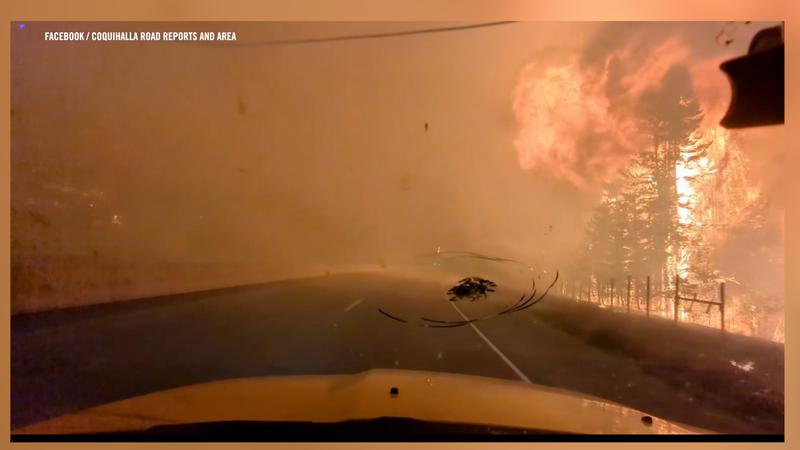
Courtesy: Facebook / Coquihalla Road Reports
MINE CREEK WILDFIRE

Crews battling Mine Creek wildfire brace for forecast wind and heat; Coquihalla remains closed

Sep 4, 2025 | 4:38 PM

KAMLOOPS — The Mine Creek wildfire northeast of Hope saw aggressive growth Wednesday (Sept. 3) afternoon. Activity was moderate until a sudden shift in wind, which quickly sent flames down the mountainside and across the Coquihalla Highway. And for more than 24 hours now, both lanes of Highway 5 have been shut down for a 100-kilometre stretch between Hope and Merritt.

Several firefighting units were sent to attack the flames, along with helicopters and other aerial resources. The swell of fire spread prompted evacuation alerts for more than 80 properties from the Thompson Nicola Regional District and the Fraser Valley Regional District, along with an evacuation order for one property. Heading into late Thursday, the BC Wildfire Service (BCWS) is expecting another surge in wind and heat.

After the Mine Creek wildfire ramped up to Rank 5 behaviour Wednesday evening, BCWS Fire Information Officer Taylor Stewart Shantz says activity toned down slightly Thursday morning, to Rank 2 and 3 behaviour.

“Unfortunately, the forecast is not in our favour and it is supposed to get quite warm and windy again [Thursday] afternoon so we’ll be watching very closely to see what the fire behaviour does at that point,” she adds.

When asked why a modified response had been used in the initial days of the wildfire’s activity, Stewart Shantz says there were a variety of reasons. In this case, BCWS used a modified response before the major spread because of the less intense behaviour the fire initially showed, reduced road access to get to the scene, steep terrain and the distance the fire had been from any infrastructure when it first began.

“Which doesn’t mean that we ignored it completely. We were flying it two, if not three times a day to monitor fire behaviour and we had a helicopter equipped with night vision that was monitoring it overnight,” reiterates Stewart Shantz. “What we really saw yesterday was just that perfect storm of very high heat, unforecast winds and some really aggressive fire behaviour that wouldn’t allow for a lot of response.”

Mike Flannigan, who is the scientific director of the Institute for Wildfire Science, Adaptation and Resiliency at Thompson Rivers University, says continued drought and the hot, dry weather from a recent upper ridge has the Interior in a vulnerable place.

“We’ve got problems already. I mean, the Coquihalla is closed because of the Mine Creek fire, the Holding Creek fire is in the Kamloops region — those are the two out-of-control fires — but we could see a lot more this weekend so if you’re out and about, be careful,” he stresses. “Don’t start a new fire. We can’t do anything about lightning-caused fires but we can do things about human-caused fires.”

Flannigan notes changing winds played a large role in what drove Wednesday’s surge on the Mine Creek wildfire.

“Those shifting winds are important because the fire spreads with the wind, and so southwest winds push it to the northeast and then the winds change to the northwest and that flank or side of the fire becomes the head of the fire and you can see rapid growth,” explains Flannigan. “This is classic setup for a bad fire situation and we’re entering into that situation.”

As of 5:00 p.m. Thursday, the Coquihalla is still shut down between Hope and Merritt. Any talk of reopening the highway lies with the province and Stewart Shantz adds that decision will likely depend on how much hazardous debris is on the road, and whether first responders can keep working safely.