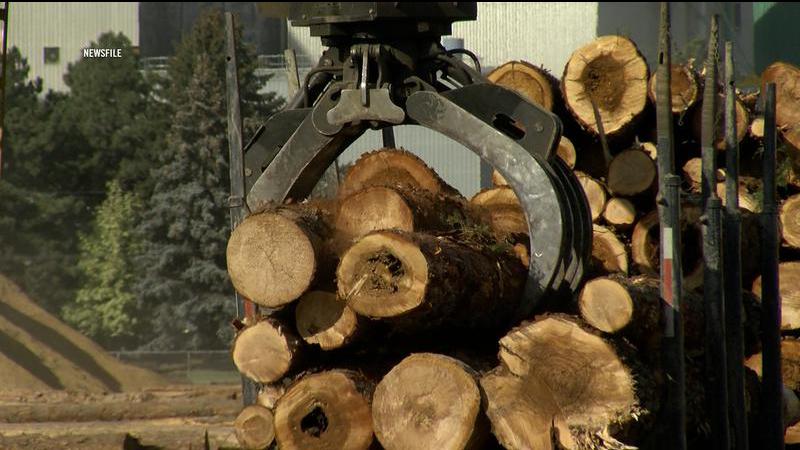
Image Credit: CFJC Today/File Photo
FEDERAL INVESTMENT

Issues remain but federal funding praised as a step in the right direction for struggling BC forestry sector

Aug 6, 2025 | 4:33 PM

KAMLOOPS — A $1.2 billion investment into the forestry sector of Canada was announced on Tuesday (Aug. 5) by Prime Minster Mark Carney in Kelowna. The Liberal leader promised $700 million in loan guarantees and $500 million to help spur product development and diversification. British Columbia is set to receive a large portion of those funds, but work remains with softwood lumber tariffs from the USA still hurting the industry.

Opposition Conservatives in the BC legislature don’t believe it’s the silver bullet to save the struggling industry in British Columbia. Kamloops-North Thompson MLA Ward Stamer told CFJC News, it’s a step in the right direction, but shifts importance to the province to step up to clear the way.

“We’ve got some significant challenges in our own system,” said Stamer. “We have a stumpage system that I would argue is broken. We have got permitting processes that were guaranteed to be sped up, they are actually slower now than we were six months ago. We desperately need to have that fibre flowing so the mills can make the decision, make the products that they need and that is really where the challenges are right now.”


BC Forest Minister Ravi Parmar confirmed that work simply isn’t stopping thanks to the influx of federal dollars, agreeing the heavy lifting is still in front of them.

“But I would agree with Ward (Stamer) that we find ways to streamline permitting. That is a big important role that my ministry has,” said Parmar. “But let’s also not forget the mess the BC Liberals left us in BC forestry — thousands of job lost, systemic forest policy changes… has broken the social fabric of forestry in communities all across this province.”

The need for a softwood lumber deal remain with the United States is likely to be a topic of discussion throughout the ongoing trade dispute with Washington.

“The softwood lumber issue between the United States and Canada has been going on longer than I’ve been alive,” said Parmar. “And I think it’s time we realize as leaders here in B.C. — but I’m sure my colleagues across the country are having the same realization — that we have to step up, we have to diversify, we have to increase the value of our products here and find new markets.”

In the meantime, Stamer is unsure how the money will help stabilize the market for mills struggling with curtailments.

‘We have the highest cost for fibre in North America. Those are structural challenges that we need to fix before we can continue on and make sure that those mills keep running,” said Stamer. “But in the short term, it’s good news. It’s encouraging that the federal government understands how important it is not only for B.C. but all of Canada to have a vibrant and healthy forest economy and I’m hoping that we can build on that.”

“In the short term, I believe these dollars will help keep mills operating and keep paycheques in the hands of workers,” added Parmar. “But I think you’ve touched on an issue that is even bigger than duties and tariffs and that is the economy in the United States.”

US building markets are slowing, dropping demand for Canadian timber.