File photo (image credit - CFJC Today)
WATER AND SEWER BYLAW

Conserve now or get taxed later: Kamloops council greenlights new water bylaw as treatment plant nears capacity

Jun 17, 2025 | 4:37 PM

KAMLOOPS — The City of Kamloops has not updated its water and sewer bylaws since they were originally created back in 1983, aside from year-to-year changes with regard to the rates paid by homeowners. City staff began a lengthy process last year to bring forward plans to update both bylaws, with the premise of rewarding homeowners for lowering their water consumption. While the new bylaw is not yet approved and would only take effect in 2027, council has given staff the green light to proceed with the changes.

The goal is to reduce water consumption across the community by incentivizing residents with rates variably based on individual water use and the removal of minimum consumption amounts.

“Under Option #4, if you use the average amount of water as a residential customer, you would have seen a 14.6 per cent rate increase — so a little bit less of what they actually saw this year, which is 15 (per cent). This option, the average customer continues to pay about the same. If you are a low water user for the residential classification, you would have seen an eight per cent reduction in your bill,” said Utility Services Manager Greg Wightman Tuesday (June 17), speaking to council’s Committee of the Whole.
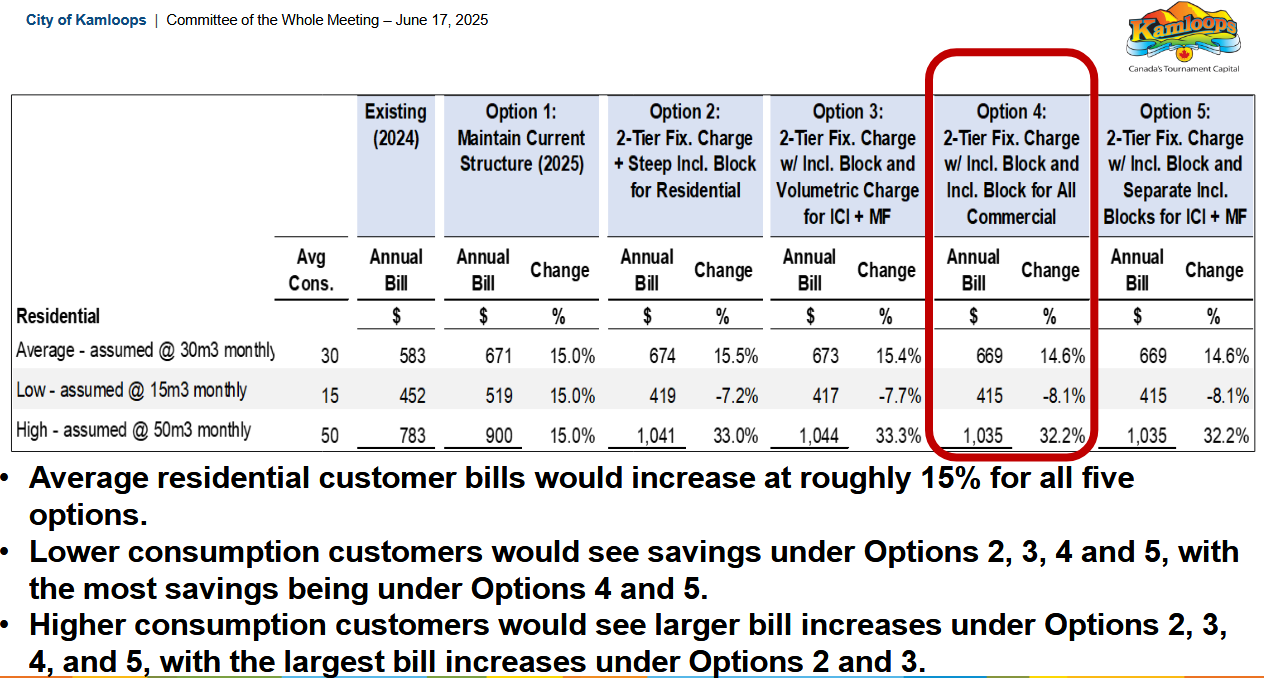
The highlighted option 4 was selected by committee (image credit – City of Kamloops)

(It’s important to note the graphic above includes a previously approved 15 per cent increase for 2025, therefore a 14.6 per cent increase would equate to a 0.4 per cent decrease from that.)

While those who conserve will see benefits, heavy users will see increases of more than 30 per cent.

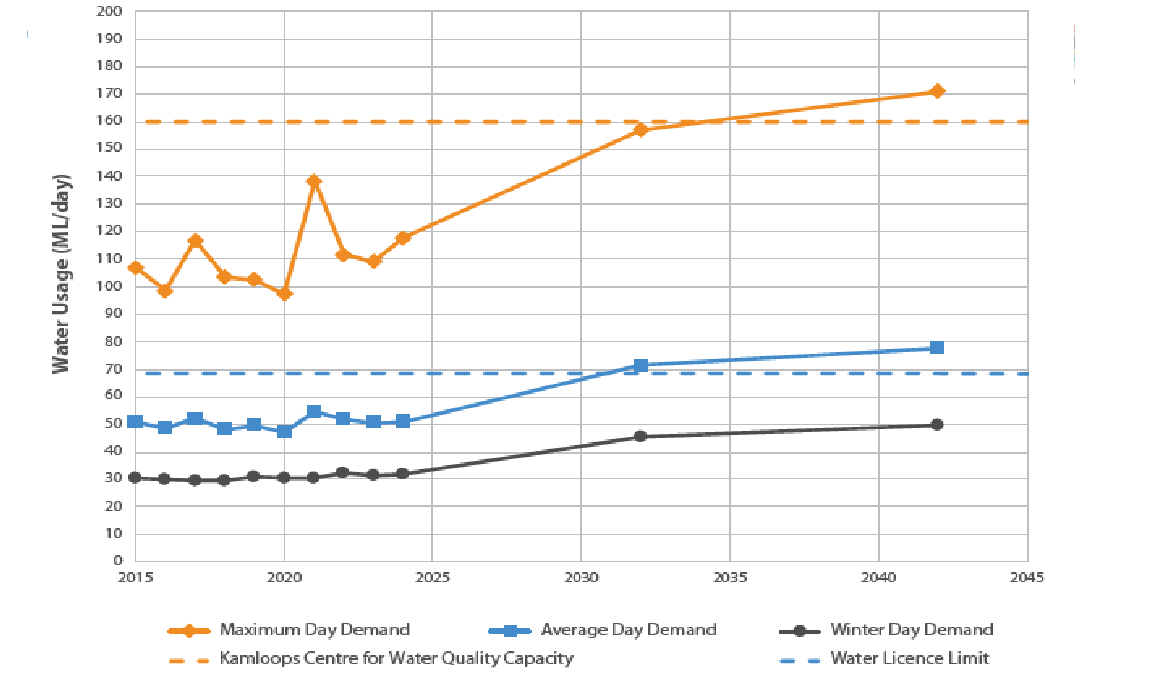
The need for further conservation is based off the city nearing capacity at the Kamloops Centre for Water Quality and, in turn, delaying major capital projects.

“If we don’t take additional efforts to try to manage that outdoor water use, that irrigation is really what it comes down to. By about 2033, we are going to be looking at a challenge with water supply,” said Wightman.

credit – City of Kamloops

“Prolonged reduction in water use may defer capacity upgrades. We saw this happen in 2011. (In) 2013, we started the universal water meter system. We deferred a whole bunch of major capital projects. We are at the point now where ,if we don’t do anything, those projects are going to come back on the books and cost us a lot of money,” said Wightman.

Decisions and discussions around the changes will still be ongoing for a number of months, with no final approval given yet. Council has asked for more information around billing cycles and food insecurity.

“If we are going to go to monthly billing under our current model, this is going to significantly increase the amount of staff time to read meters and get that information to make our monthly billing accurate,” questioned Councillor Margot Middleton.

“The last thing we want to do in 2025 is deter people who are growing carrots because they are outlandishly expensive in the grocery store. That kind of a thing. I’m curious if that has been considered and how we may be able to look at that,” said Katie Neustaeter.

Wightman noted the idea behind monthly billing is to help residents visualize their consumption and make changes, and that those with gardens were accounted for under normal water users.

“Our recommendation when we come back to council is that we maintain the current rate structure for 2026 and then provide customers with mock billing throughout 2026 with the goal of starting those new rate structures in January of 2027. (That) gives people an opportunity to see what that new structure looks like, see what the reduction in water use would mean for them,” said Wightman.

As for sewer rates, the committee approved a motion that will ensure the average resident sees no increase to their bill, while again promoting water consumption as a way to lower costs.