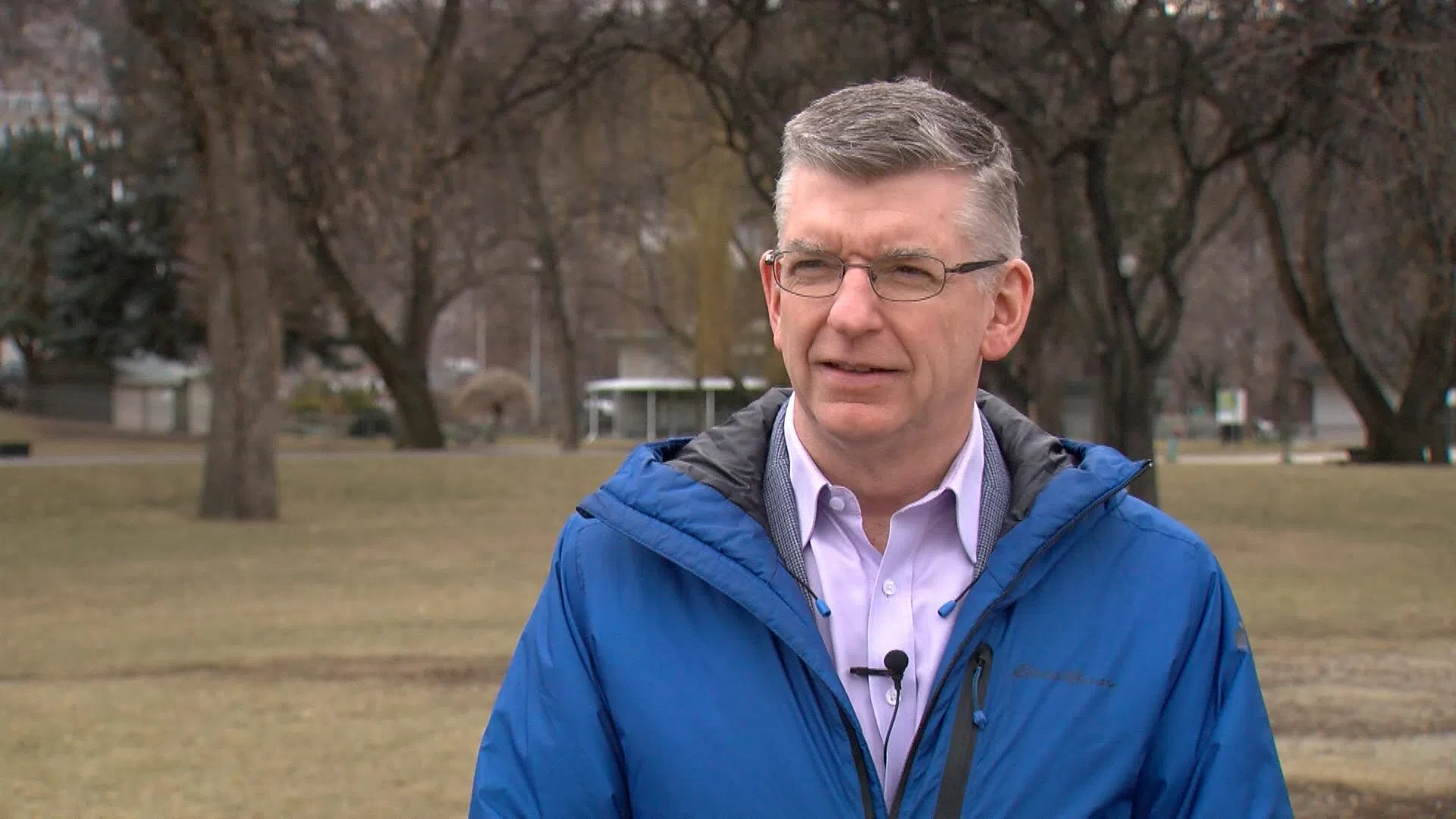
Iain Black during a stop in Kamloops (Image Credit: CFJC Today)
BC Conservative Leadership Race

‘Whatever this is, it’s not working’; Conservative leadership candidate Black lashes out at government during Kamloops stop

Feb 25, 2026 | 4:44 PM

KAMLOOPS — Iain Black is the first of two BC Conservative candidates to campaign in Kamloops this week, stopping into town on Wednesday (Feb. 25) for a meet-up with supporters downtown.


Black enters the race with the most experience of any of the Conservative candidates, having served as a cabinet minister in the former Gordon Campbell government before entering the private sector. Black believes that experience will help set him apart.

“Leadership is not something you learn in a book. I have been president and CEO of six or seven different technology companies, I ran the Vancouver Board of Trade and the unique experience in all those assignments was that they were all dysfunctional organizations that were losing money – which is kind of what our province is at the moment,” Black told CFJC News. “The second part of the experience that is critical is understanding public policy – especially economic public policy – because if we don’t get the budget sorted out, then the rest of it isn’t going to matter.”


The next leader of the BC Conservatives will be faced uniting the ‘big tent’ party that includes everyone from centrists to steadfast Conservatives. 

“I don’t find the views to be that divergent, to be honest,” said Black. “I actually don’t spend a lot of time talking or thinking about that, because I don’t think a purity test is helpful for anybody… and certainly not helpful for our party. But British Columbians don’t see it that way, so we shouldn’t either. Basic conservative values are a small government is possible to provide the most sacrosanct services of health care and education and looking out for our most vulnerable. Basic conservative values are giving people the ability to choose for themselves as to how they spend their money, that you do better with your tax dollars then the government does.”

“But also that the government doesn’t have any place telling you whether you should pray to somebody or not, and if so to whom, as long as it doesn’t infringe on other peoples rights to do the same thing. And similarly, I don’t care who you love. It’s not my place. It’s not government’s place to engage at that level. Government’s job is to pave the way and then get out of the way. Regulations have got to go. Those are values that have appeal beyond what I would call card-carrying conservatives of 1970, 1990 or 2026.

“It’s my belief that we can put together a platform and a message to the people of the province that encompasses those things, reflects the challenges around the kitchen table and on the main streets of our cities that desperately need restoring.”

Identity politics have seen a rise in recent years, but Black believes a so-called conservative purity test will do nothing to benefit the party, saying the Tories need to stay focused on the major issues.

“I think crime and street disorder, untreated mental health and addiction challenges, the lack of people’s ability to get a family doctor, the fact that a Red Bridge here in Kamloops desperately needs to be replaced – those are the issues British Columbians are concerned about, and as I have been travelling the province the last four weeks, it’s what BC Conservative members are also concerned about,” said Black. “The identity politics is not something that comes up a lot.”

Black has been out of the political arena for more than a decade, although he did run federally in the most recent election under the Conservative banner. 

“It was a gift to be involved when I was. I was the youngest MLA and cabinet minister in Gordon Campbell’s administration, the second and third of his three terms. They used to tease me and asked me if I shaved every day, I was a little bit cheeky. But it was a great experience, a great place to learn, to get that formative experience on the Treasury Board table where Gordon Campbell took a chance on me as a young technology CEO and then again to put me into cabinet,” said Black.

“But I’m drawn back into politics because I want to put all that great experience to work. Because we have got two crossroads in front of us right now that are very crucial. One is British Columbia itself. Whatever this is, it’s not working. You can’t point to anything in health care, education, taking care of our most vulnerable, criminal justice, child and family services – there is nothing that is working well at the moment and there is nothing that has been built, despite taking our provincial debt almost three times what it was when the NDP took office 10 years ago.”

“The other is the state of the BC Conservative party itself. This is a contest within the family and it’s a chance to take a fairly new organization that has a lot of growing and building to do, which again plays to my background and experience where I’ve proven I can do that a repeated number of times. That’s what makes me excited about being back in, what draws me back to the challenge.”

Like many of his leadership challengers, Black believes the province needs to repeal UNDRIP and set forward a new path with Indigenous communities. 

“I think that the biggest loser of the NDP’s agenda the last five or six years has actually been the First Nations community. I actually think the communities across the province have been so badly served by an agenda that has been largely secretive, it has been destructive, I think, to the trust that has been built up after proving that we can actually get some deals done with our First Nations communities. You look at TMX expansion, you look at LNG Canada, you look at the Coastal Gas Line – there are so many different projects that have been successfully done because partnerships were formed in good faith by our First Nations community.”

“I think the implementation of UNDRIP and the addition section of 8.1 to the Interpretations Act of British Columbia was a cavalier and reckless move on the part of the NDP government. Both of those have to be repealed because the province has become un-investable, not just within Canada but around the world. People are looking at B.C. and saying, ‘I don’t know what’s going on there but private property rights seem to be up for grabs and that is not giving us the confidence to create jobs and invest in B.C.'”

“We have to repeal those two things and then figure out how do we move forward in good faith with our First Nations community who I understand will not be particularly pleased about those changes. But the 5.7 million people of British Columbia who depend on us to govern need those things to be repealed so we can step back and then figure out how to rebuild that trust, which will take time.”

Kamloops city council spent considerable time on Tuesday (Feb. 24) pointing fingers at the province for their work around homelessness and addiction challenges. Black, as premier, has stated he will bring involuntary care to B.C. That plan begins with redeveloping the Riverview Property in Port Coquitlam into a treatment and research centre, and expanding service out to individual communities.

“Places like Kamloops would have some of the treatment that is required, which would include involuntary care. It’s not longer acceptable for us to let the human travesty that you are seeing here in Kamloops, you’re seeing it in Kelowna, Fort St. John, Prince George, obviously the Downtown Eastside of Vancouver and it is now everywhere and whatever we have been doing isn’t working.”

“Involuntary care must be part of this. We have to take people off the streets who can’t take care of themselves. That will face some challenges in court and, as premier, I will take on those challenges right to the Supreme Court of Canada if we need to. Because we can’t allow our children and our parents and siblings to live that way.”

Black added he would add more police resources and give them more tools to crack down on gangs.

The most recent NDP budget shows a deficit of $13.3 billion. For Black, a path back to balanced books will take time. 

“We should start by actually doing some building in British Columbia. For all the money that has been squandered by this government, there is nothing to show for it. Show me the roads, the schools, the bridges – there is none of them. And so we need to get back to building the infrastructure needed to start our economy working again. We need to do things like getting rid of the regulatory burden on small business, which I plan to roll back to 10 per cent less than 2017 levels.”

“If you don’t have the resource communities doing well, the Lower Mainland is not doing well, either. There is a direct connection between forestry, mining, oil and gas, and the 100,000 people who are employed within five kilometers of the waterfront of the Port of Metro Vancouver. That linkage is very clear to me. Part of the mandate to get the economy back on its feet and make sure Kamloops and other cities like Kamloops are thriving is to make sure that we become the department of ‘yes’ instead of the department of ‘no’, which is what we’ve experience for the last nine years.”