(Image Credit: Jennifer Billingsley)
DOG ATTACK

Sagebrush family shocked by Kamloops CSO decision to return dog home after attack on child

Dec 18, 2025 | 5:13 PM

KAMLOOPS — A Kamloops family is calling for stronger enforcement surrounding animal attacks after their son was brutally mauled by a dog three weeks ago.


The incident caused life-altering injuries to a 10-year-old child and instead of being euthanized, the dog was labelled as aggressive by City of Kamloops Community Services and returned home to its owners. The boy’s family is outraged and wants more detailed information into why the city’s Community Services department didn’t pursue destruction proceedings.

Instead of getting ready for Christmas as usual this year, Jennifer Billingsley and her family are recovering after their son Jackson was mauled by a dog in a downtown Kamloops neighbourhood.

“This was an unprovoked attack on a 10-year-old boy whose life will be altered forever,” Billingsley told CFJC Today Thursday (Dec. 18).

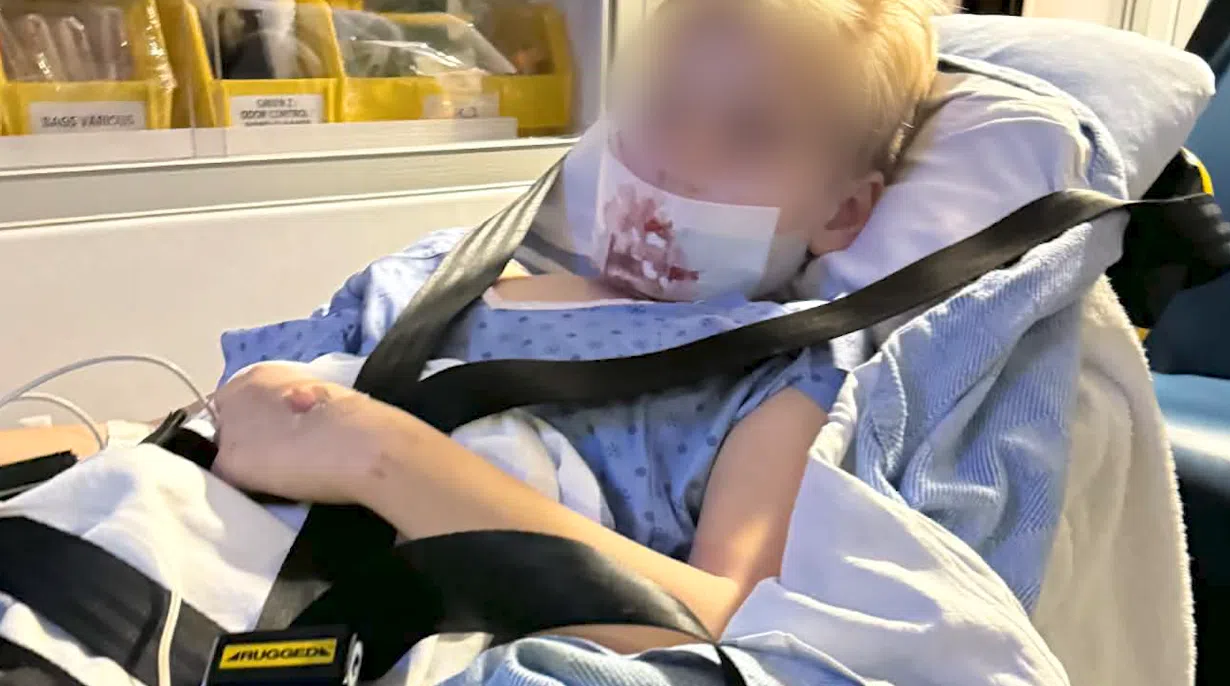
On the afternoon of November 26, 10-year-old Jackson and his friends were saying hi to a neighbour and were invited to meet a dog belonging to someone staying at the neighbours’ home. The dog rushed Jackson, bit his face, bit through the boy’s hand and had to be pulled off twice.

“Jackson then ran home. I heard the commotion, came downstairs and he was just turning the corner to go into the bathroom, and all I could see was just blood,” recalls his mother. “He had a huge gash across his cheek, and then another one, so it was folded over. His lip was shredded and just hanging. He had a gouge by his chin and along his cheekbone and just one below his eye. The doctor did tell us we were very lucky that it wasn’t any higher because he would have lost his eye.”

Jackson was rushed to Royal Inland Hospital in Kamloops, where it was determined his injuries were so severe he had to be transported to Kelowna to see a plastic surgeon specializing in traumatic injuries.

“This isn’t somebody who got their finger nipped or somebody who got scared by a dog barking,” Billingsley reiterates. “This is someone who was mauled in his own neighbourhood.”

While the child was recovering after surgery and reading ‘get well soon’ letters from his classmates, the dog was seized and assessed by a behaviour consultant. Out of that, Billingsley says the animal was designated as an aggressive dog but released to its owners under specific conditions it stays in the yard, is leashed and muzzled.

“We were told by the people who live in the house that they’re not putting the dog down and that they’re doing everything by the letter of the law — which they are because the city has allowed them to go back,” she says, “but the city isn’t checking in. They don’t have the resources to be able to ensure these people are following the rules, so it’s passive. The only way we will know if something has happened is if somebody takes a picture of it happening and sends it into them or if there’s another attack.”

Billingsley felt the investigation into the incident wasn’t thorough enough and needed more interviews to be gathered, including from her son, before a decision was made.

“At the end of the day, our community is three blocks from three different schools, two of which are elementary schools. It’s a walking path, kids are walking by there every day,” she stresses. “It’s just not an acceptable outcome for our community safety.”

The family asked to appeal the decision that came out of the behaviour assessment, but was turned down. Billingsley has now applied to receive the dog’s assessment report through a Freedom of Information request, and depending on what that report says about how the city reached its conclusion, she’ll be considering legal action.

Troy DeSouza is a lawyer with Dominion GovLaw, who has worked on many dog attack cases in British Columbia. He agrees that, in this instance, the family’s next move should be to get more information about why the city decided not to pursue applying to have the dog euthanized.

“The parties that could be held responsible are primarily the dog owner and the owner of the property where the dog resided. Those are sort of the key nexuses there. I think it’s harder to bring in some liability to the city unless there is something that they knew or ought to have known with respect to that dangerous dog,” DeSouza says.

Billingsley says the city pointed to its duty to taxpayers in not pursuing destruction proceedings under the Community Charter, where the likelihood of success is low. But DeSouza says there normally is a high likelihood of getting an order from a provincial judge on humane destruction when it is related to extensive injuries from an unprovoked attack on a child.

“I would agree with the city where they say, ‘Well, you know, if there’s an unreasonable likelihood of success then I don’t want to spend the taxpayer dollars. I agree, full stop. But if that basis of assertion is wrong, then you have to look at public safety because the taxpayer dollars will be a lot more if someone else gets hurt,” he explains. “That’s where liability exposure lies, so it’s a bigger picture. You can try and save some money here but you’re going to end up paying it later if that dog goes out and injures another person, and then there’s the impact to that next victim. There’s a bigger picture here and it’s all about public safety.”

CFJC reached out to the City of Kamloops Community Services Department for an interview about the incident, but did not hear back by deadline.