Image: Michael Grenier
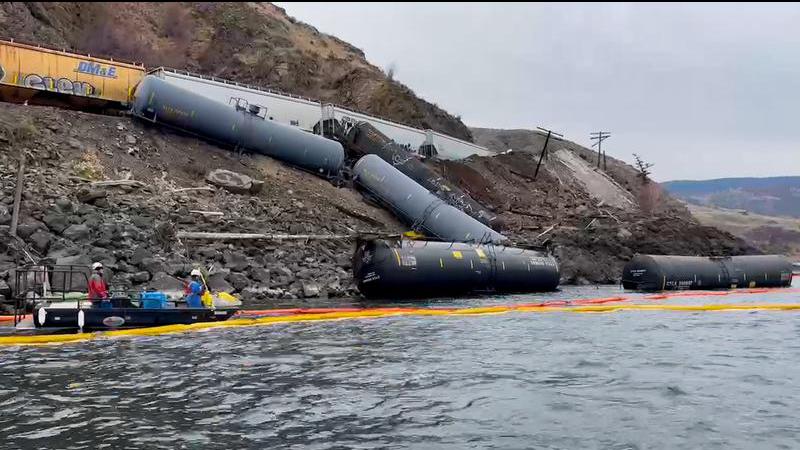
Cherry Creek Derailment

Gypsum to be cleared away from CPKC derailment site near Kamloops ‘in the next few weeks’

Nov 21, 2025 | 11:56 AM

CHERRY CREEK, B.C. — Officials are still finding no impacts to drinking water systems after a 17-car train derailment near Cherry Creek that happened nearly three weeks ago.

That’s according to the Thompson-Nicola Regional District (TNRD), which operates water systems in Savona and Walhachin.

“At this time, no impact is expected to these systems as a result of the (Canadian Pacific Kansas City) CPKC derailment, and any change in status will be communicated by the TNRD through Voyent Alert! if necessary,” a Nov. 20 statement from the TNRD Emergency Operations Centre said.

“If you have questions about a private water system or intake from Kamloops Lake, contact the appropriate water provider.”

While all railcars have been cleared away, TNRD CAO Scott Hildebrand said recovery operations are still ongoing along the shoreline of Kamloops Lake.

“[The TNRD] attended coordination calls with Natural Resources, with the Ministry of Environment, with First Nations, with CPKC and other ministries,” Hildebrand said at the Nov. 20 TNRD meeting.

“We worked closely with unified command to identify water intakes and accessing for testing, and strongly lobbying for testing both upstream and downstream.”

In a statement, the Ministry of Environment and Parks says it has developed a plan to recover all of the gypsum left on the embankment and shoreline of Kamloops Lake in the next few weeks, though it’s not clear when exactly work will be done.

“Shoreline treatment is ongoing on both the South and North shoreline of Kamloops Lake,” the ministry added. “Shoreline flushing operations are being prioritized on the north shore in anticipation of winter conditions.”

According to the province, 70,536 litres of aviation fuel was spilled into Kamloops Lake after the Nov. 1 derailment. Four of the 17 railcars that went off the tracks were loaded with fuel, five contained gypsum and one was carrying pulp.

While the other railcars were empty, three of them had previously contained gasoline.

“We are very engaged with this one, given the amount of fuel that spilled into the lake,” Hildebrand added. “The responders continue to complete what they call SCAT (Shoreline Clean-up Assessment Technique) assessments and that’s been going well.”

At a public meeting in Savona on Nov. 10, CPKC said a rockslide may be partially to blame for the derailment, though the railway’s Indigenous relations and government affairs director Mike LoVecchio said the exact cause is still under investigation.

“Our investigation involves eliminating potential causes as well as naming them,” LoVecchio said. “That takes time.”

“Our analysis thus far does not indicate, however, that there’s any connection to other incidents along the main line.”

The Ministry of Environment is expected to provide another update on the clean up efforts next Thursday (Nov. 27). The TNRD also said it continues to get weekly water samples taken at the Savona Community Water System intake.

It is also asking people to contact the Ministry of Environment through the RAPP Line at 1-877-952-7277 if they spot oil or other substances on Kamloops Lake.