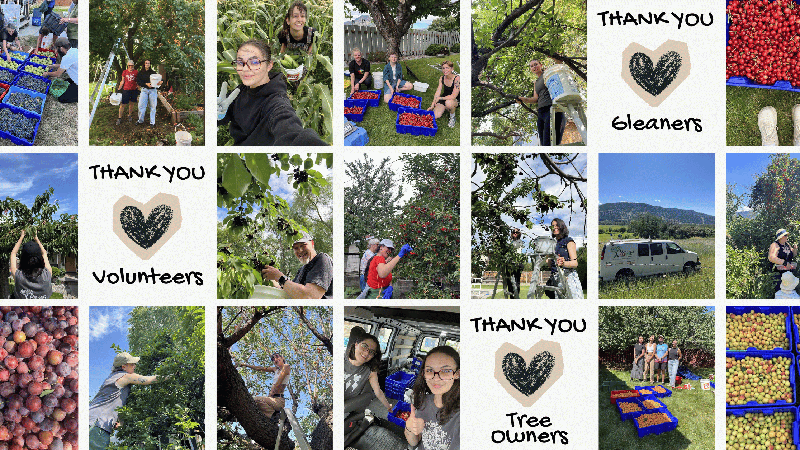
Image Credit: Kamloops Food Policy Council
Sound Off

SOUND OFF: That’s a wrap, GAP — thank-you for a successful season

Nov 15, 2025 | 6:00 AM

SITTING UNDER A MARKET TENT in June with Naya Macaulay, my friend and fellow team member at the Kamloops Food Policy Council, a woman strolling up to our booth at the Yew Street Block Party told us, “If you live in Kamloops and have to buy apricots, then you clearly don’t have enough good friends.”

We laughed and resolved to put that quote on a sticker to bring to future markets, but I confess I had felt a twinge of doubt about that statement at the time. Before becoming the community engagement coordinator at the KFPC, I lived in Victoria for three years, completing my undergrad at UVic, where I grew disconnected from the landscape and ecosystems of my own hometown. I had forgotten about the apricots falling like rain onto sidewalks during the summer months, creating fetid piles of fermentation — all that good food going to waste.

I knew I was signing up for a summer surrounded by fruit trees when I took on the responsibility of running the Gleaning Abundance program (GAP), but I admit I hardly knew the first thing about them. My knowledge of homegrown produce came from the sprawling vegetable and flower gardens I grew up surrounded by at Shuswap Lake, belonging to my parents and my grandparents. Patches of garlic, onions, and carrots, flanked by towering smoke bushes and hydrangeas. I like eating fruit as much as the next person, but I still had a lot to learn.

For example, something I learned quickly was, from the early 1900s until the late ‘50s, the North Shore, Brock and Westsyde were home to massive orchards and farms, but once the land was developed, becoming vastly residential, many of those remaining orchard trees ended up in people’s backyards, which is why a large majority of our harvests take place in North Kamloops. I found it fascinating to learn this tidbit of my hometown’s history — highlighting just how necessary the GAP really is here.

Cherry season began slowly as the program commenced for the season. We ran into unexpected heavy rainstorms, inhibiting our ability to harvest safely. Because of this, many of our harvests had to be postponed, cancelled or rearranged. Additionally, many tree owners broke the news that their cherry trees had died in the cold snap last winter, shrinking our harvest list significantly. I was feeling discouraged but knew apricot season was just around the corner. By the end of the cherry season, we had harvested 448.6 lbs. I was proud of our progress, but little did I know, this would pale in comparison to our total harvest numbers at the end of the summer.

I had no idea the volume of apricots that would inundate the program once July rolled around. Driving through Kamloops, I saw them everywhere — trees began revealing thriving apricots before my eyes, exploding in hues of orange and red. With the responsibility of the program on my shoulders, the guilt I felt was enormous as fruit began to fall. I scrambled to reach as many apricot tree owners as possible in the brief time we had. With the help of Faith Bellamy, our former GAP coordinator, we did everything we could to help tree owners and engage our volunteers, but the process came with its challenges. We were a team of two, with one of us leading a single harvest weekly, there was still the massive task of distribution after every harvest. Time was of the essence, and we needed to keep our momentum going without becoming overburdened. There was also the extreme heat, which made scheduling difficult. We kept heat safety in mind and began gleaning exclusively in the evening, when the sun began to set and temperatures dropped. Once apricot season came to a close, we had harvested a whopping 3142.7 lbs of apricots.

Fall brought us an exciting variety of fruit. Harvesting conditions improved, 20 degrees in the evening, a breeze indicating the upcoming changing of the leaves from green to sunset tones. Our GAP systems were dialled in, the chaos of summer had settled down. From September to October, we harvested 11,875.9 lbs of produce, including apples, pears, grapes, plums and 2000 lbs of corn from Burkholder Bros farm out in Chase, which made for a fun field trip.

Our volunteers were absolute troopers through it all, arriving in good spirits, thrilled to help, bringing great stories and experience from previous years participating in GAP, which I am so grateful for. I heard all about the amazing recipes they would use the fruit for, which inspired me to get into the kitchen and try some out for myself. On behalf of the team of the Kamloops Food Policy Council, thank-you so much to our volunteers! We couldn’t have had such a successful season without you all.

After 67 harvests, our grand total for the 2025 season of the Gleaning Abundance program was 14,911.9 lbs of produce — the approximate weight of a full-grown male elephant! We distributed to 26 organizations in Kamloops, including the Mustard Seed, Mount Paul Community Food Center, the Y Women’s Shelter, PitStop, Kamloops Aboriginal Friendship Society and many more. I now understand what that woman at the Block Party had meant — the gleaners are good friends and we will always share our bounty with our community. We have more than enough food — and joy — to go around.

If you would like to make a difference in Kamloops and help us share produce with those who might otherwise go without it, or if you just want to get outside in the summer and meet some amazing people, please consider signing up as a volunteer on our website. You can also register your fruit tree, farm or garden on the same page if you are interested in having your produce gleaned and shared throughout the community.

We can’t wait to see you next year!

——

Editor’s Note: This opinion piece reflects the views of its author, and does not necessarily represent the views of CFJC Today or Pattison Media.