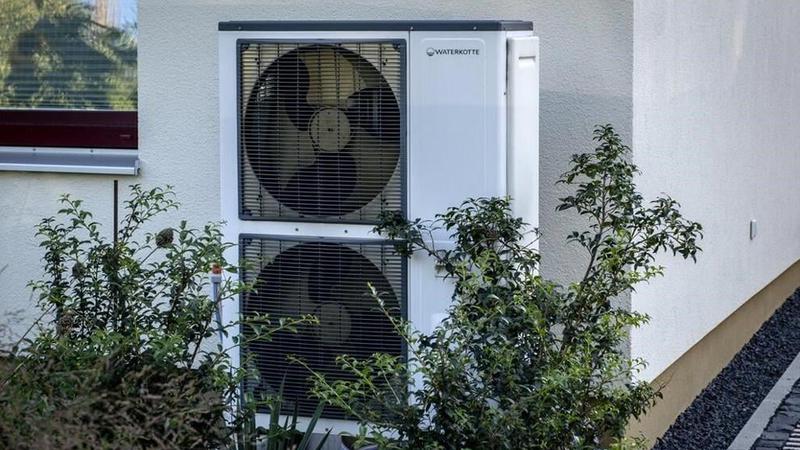
A heat pump is installed at a house in Frankfurt, Germany, Thursday, Sept. 7, 2023. THE CANADIAN PRESS/AP-Michael Probst
Heat Relief

Kamloops council to urge B.C. government to offer financial relief during extreme heat waves

Oct 28, 2025 | 6:55 AM

KAMLOOPS — Kamloops council will be calling on the province and BC Hydro to offer financial relief to low-income British Columbians during times of extreme heat waves.

Councillor Dale Bass’ notice of motion is calling for measures like supplemental bill credits and more income-qualified rebates for heat pumps and portable cooling solutions. It is also calling for the development of a long-term energy affordability strategy that includes equitable billing models and protections for “essential cooling.”

The province is also being urged to coordinate with municipalities, utility companies and public health agencies to ensure there are clear protocols set out around cooling centres and public-awareness campaigns to support people during heat emergencies.

“This one came to me through a person on Bluesky,” Bass said. “He posted about how it was so hot in the house, he was worried about the health of his children, but he was afraid to turn on the air conditioning because it was going to take his bill up into the second tier.

“I wonder how many seniors who died in the last heat dome didn’t want to turn out their air conditioner — if they had one — because they knew it was going to go into a higher bill tier.”

A BC Centre for Disease Control study which looked at 2021 heat dome deaths concluded that a person on income assistance was almost 2 1/2 times more likely to die during a heat wave.

The heat dome from June 25 to July 2, 2021, was the deadliest extreme weather event in Canada’s history. Temperatures climbed 16 to 20 C above seasonal, and a review later determined that 619 people lost their lives due to the heat, with 17 of those in Kamloops.

Lytton set the record for Canada’s hottest temperature at 49.6 C. The next day, a wildfire destroyed most of the Fraser Canyon community. Kamloops also hit a high of 47.3 C during that heat dome in 2021.

Bass said with extreme heat emergencies becoming more frequent because of climate change, the resulting health and safety risks tend to disproportionately affect people already disadvantaged by poverty and inequality.

“I see this [motion] as just a first step. Let us try this and see what happens,” Bass said.

“Maybe BC Hydro has evidence to show that this isn’t an issue. I don’t know if they would, but maybe they do. Maybe other communities are considering this as well. I don’t know. But you aren’t going to know unless you throw it out there and see what lands.”

A copy of the approved motion will be sent to both Kamloops MLAs and both MPs, BC Hydro and the BC Utilities Commission, and the provincial ministers of emergency management and climate readiness, health, as well as energy and climate solutions.

While Bass’ original motion also included a clause seeking the implementation of automatic bill credits or temporary rate freezes for residential customers during declared extreme heat emergencies, it was left out of the final motion that was passed on Oct. 7.

“There are reasons to have incremental rate increases,” Councillor Nancy Bepple said. “One of the most important reasons is you may be subject to brownouts. I think [clause] number two meets the needs of people who might not otherwise be able to afford electricity costs, but I don’t support number one.

“I think it has too many other consequences.”

Bass said she was fine with council’s decision to omit the first clause of her motion, as she wanted to get the conversation started as soon as possible. It’s also why she only focused on extreme heat and not extreme cold.

“I didn’t want to get it muddied up with both extremes,” Bass told CFJC Today. “I think if we look at one extreme and we find that it has some legs and there is something to do, then it naturally would flow and we would look at the other side of the coin when it’s really cold.

“We’ll just see where this goes. It might not go anywhere, but you’re not going to know unless you ask the question.”