Image Credit: Kent Simmonds / CFJC Today
PARKS CANADA DESIGNATION

Multi-language plaques mark National Historic Site designation of former Kamloops Indian Residential School

Oct 23, 2025 | 4:51 PM

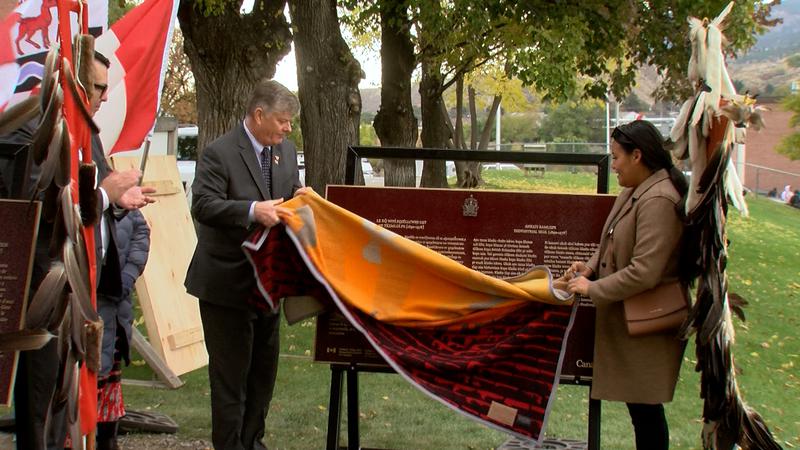
TK’EMLÚPS TE SECWÉPEMC — Tkʼemlúps te Secwépemc leadership hosted Parks Canada and other national dignitaries Thursday (Oct. 23) to unveil the new plaques outside the former Kamloops Indian Residential School.

The building was announced as a national historic site in February. Tkʼemlúps says installing the plaques will make sure information on the residential school site is readily available. While restoration work and other upgrades are ongoing to make sure the aging building can preserve its functionality and maintain its role as a national historic site.

The red brick building sitting among a collection of band facilities on Chief Louis Way was once the largest residential school in Canada. Eventually it became a band-owned office building and, most recently, it was named a national historic site by Parks Canada.

“It’s definitely all about reclamation.” Tkʼemlúps te Secwépemc Kúkwpi7 Rosanne Casimir reiterated Thursday.

“A declaration of the residential school, the impacts, but it’s also that declaration of history,” she adds. “Recognizing those truths and also being able to support those who want to learn more.”

The path to its historic site designation dates back to a general band meeting in 1978 after Tkʼemlúps gained possession of the building. There was debate among members on whether to take a wrecking ball to the former institution that represented pain for so many, or keep it and reclaim the space.

Le Estcwicwéy̓ (which translates to ‘The Missing’ in Secwepemctsín) Manager Jeanette Jules, says having those plaques and the national site designation is another tangible way to acknowledge the past.

“We’re bringing our history back, showing that this place did exist, and many people went through it,” Jules stated from the podium Thursday.

The bronze words unveiled on plaques this week relay information about the residential school and the thousands of Indigenous children who attended from more than 108 different communities.

Ron Hallman, the CEO of Parks Canada, attended the commemoration event Thursday and says the designation does fall in line with the priorities outlined in the National Truth and Reconciliation Commission’s Report and Calls to Action.

“Historic designations of residential schools contribute to addressing Call to Action 79 in the Truth and Reconciliation Commission,” he told the crowd in attendance.

Four different languages were used — English, French, Secwepemctsín and Chinook — which is a hybrid language used around B.C in the 1800-1900’s for trading and relaying current events.

“Very few people are fluent in Chinook. And so I know there’s very few people so I think it should be something that people take an interest in because it’s a real historical piece of language that was understood by many back then,” notes Casimir. “More than our own Secwepemctsín.”

The plaques and the designation that comes with them also mean upkeep of the building will continue, serving as another way to make sure that part of history is accessible to future generations.

“We are looking at some renovation projects — and it is a national declaration site, so we’re always going to be preserving that history. That’s 88 years of history,” reiterates Casimir.