Image Credit: Contributed
Blue-Green Algae

Nicola Valley area residents, politicians looking for answers after latest blue-green algae bloom

Jul 7, 2025 | 4:48 PM

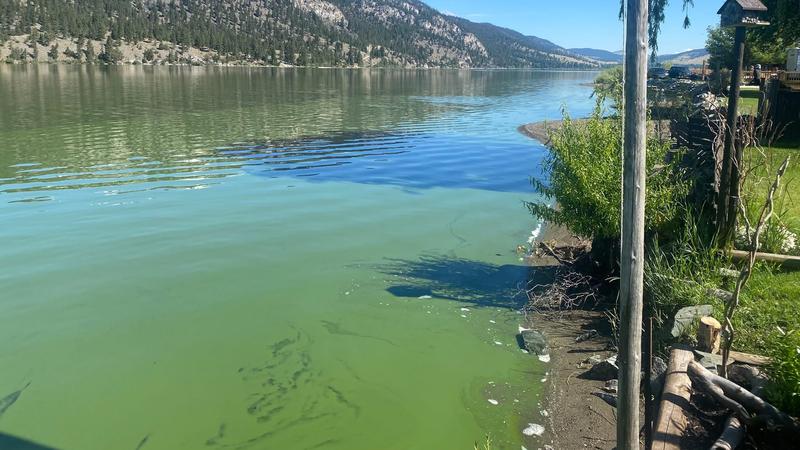
MERRITT — A Thompson-Nicola Regional District (TNRD) Director for the Nicola Valley area says residents are looking for answers following the latest blue-green algae bloom.

While its not a new issue, David Laird, who represents Area “M” (Beautiful Nicola Valley – North), told CFJC Today that at least two pets have died after they came in contact with the water on Nicola Lake. Other pets have also become ill according to posts on social media.

“I’ve lived at the lake now for 20 years almost and this is by far the earliest its come in,” Laird said of this latest algae bloom. “It was really bad last year but it only lasted, I think, about five days, and it was late. I think it was in August, so its quite different this year.”

In a Facebook post early Tuesday (July 1), the Phases Veterinary Emergency Hospital said it had seen several suspected cases of blue-green algae coming from the Nicola Lake-area over the previous weekend.

“This type of algae is highly toxic, potentially leading to death in a matter of hours,” the post said. “We have yet to confirm these cases, however, we recommend avoiding these areas and keeping pets out of the water.”

Later that day, the Upper Nicola Band also published an advisory online that asked people to avoid all contact with algae blooms on Nicola Lake.

“Weather and wind conditions can cause algae blooms to move from one location in the lake to another,” the Upper Nicola Band said.

“Given the shifting nature of algae blooms and the ever-changing potential for toxicity from day to day, testing for toxins is not always reliable. Instead, it is safest to assume the blooms may contain toxins and adhere to precautions.”

Laird said there are several factors that seem to be exacerbating the issues this year including septic tanks, cattle, fertilizers as well as increased temperatures in the lake.

“It’s all manmade, the fact that we get such a heavy bloom, “Laird said. “It’s cattle, its fertilizers, its septic tanks and we have to start fixing it. We created it.”

“It wouldn’t be happening if it was a regular free-flowing lake but we have to start looking and seeing how we can fix it,” he added. “When the wind comes up it blows the blooms which ever way the wind blows so it moves all over the lake’.’

Laird also told CFJC that he’s only seen the one warning sign in the Monck Park area advising people and their pets to stay out of the water.

“It a real small sign and it says ‘algae bloom in effect. Swim at your own risk,'” Laird noted. “There are at least three public boat ramps and then there is everybody that lives around the lake that has boats.”

“I can see algae in the lake and there are people out there boating. I watched a Sea-Doo tear around in the water all afternoon (Friday) and if you drink the water, it could be lethal.”

According to Interior Health, common symptoms from exposure to blue-green algae include diarrhea, fever, rashes, sore throat, and vomiting.

“To date, Interior Health is not aware of any human illnesses related to algae bloom toxins,” Dr. Andy Delli Pizzi, a Medical Health Officer, said in a statement. “If you’re showing any of the symptoms listed and believe they may be from exposure to blue-green algae, please contact your health-care provider or call 811.”

Local officials allege lack of Provincial response

Laird said he’s been working with fellow TNRD Director Herb Graham, who represents Area “N” (Beautiful Nicola Valley – South) as well as Fraser-Nicola Conservative MLA Tony Luck to try to get the provincial government to respond to the issues that area residents have raised.

He said he was set to listen in on a call that the Province hosted on Friday (July 4), but was later told that as an elected official he would not be able to be part of the call, adding “he doesn’t understand that thinking.”

“It’s been taken quite lightly by the provincial government,” Laird said. “We talked to somebody in the Ministry of Environment and they knew a little bit about the algae bloom, but they didn’t know that it was killing animals.”

“[The residents] tried to get this dealt with last year but we couldn’t even get the government to come and talk to us. This year, we’re hoping that they listen and come and get something done, especially with signage.”

In a statement, a Ministry of Environment spokesperson told CFJC Today that warnings have been posted in Monck Provincial Park – at the request of Interior Health – and that the park website has been updated.

“BC Parks takes recommendations from the local health authority regarding algae-related health warnings,” the statement said. “BC Parks and Interior Health will continue to monitor the situation and update information as required.”

“There is nothing more important than the safety of people visiting our parks.”

It said people with concerns about blue-green algae in a body of water used for drinking or for recreation should call Environmental Health at (250) 565-2150.

Delli Pizzi also urged people to follow all posted signs and to avoid contact with all bodies of water with visible algae blooms.

“BC Parks and the Upper Nicola Band both have advisories in place for Nicola Lake, and a permanent advisory is posted at the campgrounds and day use area at Monck Provincial Park due to the history and risk of potentially toxic algae blooms,” Delli Pizzi said.

“From a health perspective, we recommend people avoid swimming or drinking water when algae is present in a lake. If algae blooms are suspected keep pets out of the water, and don’t allow pets to drink the water.”

When it comes to notifying people about water safety, Delli Pizzi said Interior Health works in a supportive role.

“Beach owners and operators are responsible for monitoring and advisories, and may test algae blooms for the presence of toxins in partnership with the health authorities,” he said.

Both the Ministry of Environment and Interior Heath also urged people to report all algae blooms online.