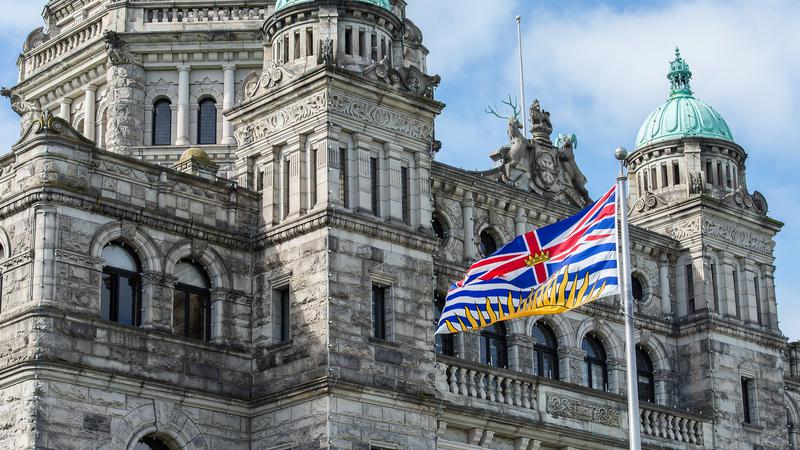
Image Credit: Flickr / Province of BC
BC Budget

‘Focused’ not ‘flashy’ B.C. budget posts record $10.9B deficit amid Trump tariffs

Mar 4, 2025 | 2:02 PM

VICTORIA — Under the shadow of stiff new U.S. tariffs, the British Columbia government has unveiled a 2025 budget heavy on red ink and light on frills.

Finance Minister Brenda Bailey delivered her first provincial budget on Tuesday, the same day U.S. President Donald Trump imposed punishing tariffs of 25 per cent on Canadian goods and 10 per cent on Canadian energy.

Bailey acknowledged the budget was not “splashy,” framing it instead in terms of protecting jobs and core public services, while growing the economy.

“President Trump’s tariffs could put tens of thousands of British Columbians out of work (and) significantly impact our province’s finances,” Bailey said.

“The impact will be severe. Budget 2025 is about standing strong for B.C. and making sure that the public services are there when we need them.”

The budget estimates Trump’s tariffs could shave up to $1.4 billion from government revenues on top of the modelling it is based on.

In response, the nearly $95 billion spending plan earmarks a hefty $4 billion per year in contingencies.

Bailey said the province is also expecting unspecified financial assistance from the federal government from its retaliatory tariffs, to be directed to impacted sectors of the economy.

The new budget revises the deficit for the last fiscal year down by just over a quarter-billion dollars to $9.1 billion. But it forecasts the 2025 deficit will climb to a record $10.9 billion on increases in capital and program spending.

The province is putting up about $15 billion in capital funding per year, much of it going to new and expanded schools and hospitals. However, much of the money is going to projects already in the pipeline, such as the Broadway subway and Surrey-Langley SkyTrain line, new Surrey and St. Paul’s hospitals and Massey Tunnel replacement project.

On the operating side, it includes $7.7 billion in new program spending over three years, with $4.2 billion going to health, mental health and addictions, $2 billion going to income and disability supports, $993 million for children and family services and $370 million going to K-12 education.

Just over $2 billion of that money will flow this year, more than half of it going to health, mental health and addictions care.

The budget increases the speculation and vacancy tax, which targets empty homes, from 2 per cent to 3 per cent for foreign owners and from 0.5 per cent to 1 per cent for Canadians in 2026, a measure expected to raise $47 million in the 2027 fiscal year.

Absent from the budget are several key campaign promises the NDP made ahead of the 2024 election, including funding for education assistants in all K-3 classrooms, funding to extend the Broadway subway to UBC or details on an expanded involuntary drug and mental health treatment program.

Economic supports

Tuesday’s budget includes a limited suite of measures aimed at diluting the impacts of Trump’s tariffs on the economy and the public.

The province is spending $410 million this year on a new $110 ICBC rebate for drivers. It’s also putting up $375 million for rent subsidies to low-income people, and adding another $318 million to its BC Builds housing program.

On the business side, the province has earmarked $30 million over three years to the “Integrated Marketplace Initiative,” a program to help tech companies expand into new markets.

It is also boosting tax credits for the film, video and VFX sectors, and is increasing the Small Business Venture Capital Tax Credit annual limit from $120,000 to $300,000.

To take advantage of growing demand for critical minerals, the province says it is also extending the New Mine Allowance through 2030.

Pressed on whether the tax incentives were enough to draw companies to B.C. amid Trump’s trade war, Bailey said the province was taking other actions that would help businesses’ bottom lines.

“There are many things we can do with the mining sector and other categories of business that are not included in just tax measures, such as accelerating permitting,” she said.

The hard numbers

The three-year window of the fiscal plan paints a picture of gathering economic storms.

It anticipates a GDP growth of just. 1.8 per cent this year and 1.9 per cent next year amid global economic uncertainty.

This year’s record deficit is forecast to ease slightly to $10.2 billion next year and $9.9 billion the year after.

The province’s debt picture is also historic. Total debt is forecast to climb to $156.6 billion this year, $118 billion of it supported by taxpayers.

That leaves B.C. with a 26.7 per cent debt to GDP ratio, costing the province 4.9 cents per dollar of revenue in interest payments. The total debt figure climbs to nearly $209 billion by the end of the three-year fiscal plan, $166 billion of it supported by taxpayers, with an interest bite of just under seven cents per dollar in 2027/2028.

Bailey insisted the debt situation remained “manageable,” adding it was “favourable compared to other provinces” such as Ontario and Quebec.

She said the province was taking steps to get the province’s finances back on track, including a public sector hiring freeze, setting $1.5 billion in expenditure management targets over the three years and launching program reviews aimed at efficiencies across ministries.

Adding to the uncertainty, the province’s revenue assumptions include the presence of a carbon tax over the three-year period, worth more than $3 billion a year. The province has pledged to scrap the consumer side of its carbon tax if Ottawa drops its requirements for provinces to have one.

“We have to wait and see what happens to the federal government,” Bailey said, acknowledging the change appears likely.

“There will be an impact to that, and we have some planning going on right now on what that would look like.”

The budget also provided an updated snapshot on the province’s forecast of the damage the trade war could wreak on the B.C. economy, based on the specifics of Trump’s tariffs, the federal government’s response and anticipated supports from Ottawa.

The province now estimates a $43 billion hit to GDP by 2029, down from $69 billion by 2028 estimated in January, and up to 45,000 job losses, down from 124,000 by 2028.

The new forecasts project an unemployment rate of 6.4 per cent this year and 6.7 next year, down from 6.7 per cent and 7.1 per cent respectively, as forecast in January.

And the new forecast estimates between $3.2 billion and $5 billion in lost corporate profits, down from $3.6 billion and $6.1 billion estimated in January.