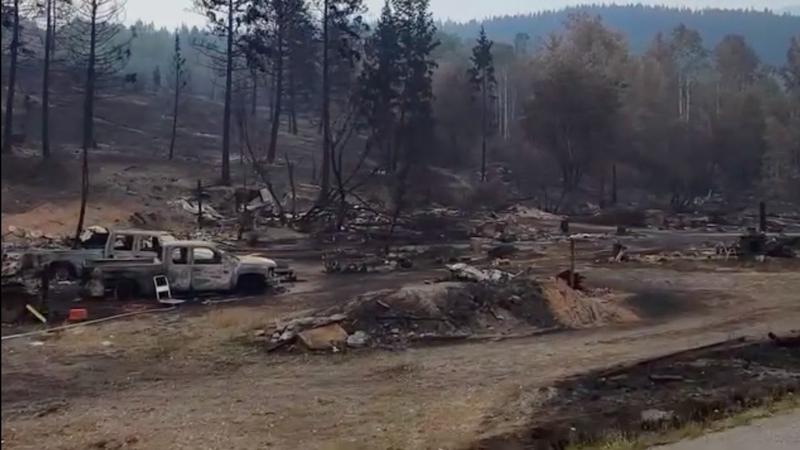
Image Credit: Kent Simmonds
Armchair Mayor

ROTHENBURGER: Community expertise needs to be brought into the wildfire fight

Aug 26, 2023 | 7:46 AM

HEROES OR FOOLS? Those who refuse to evacuate and who instead stay behind to defend their homes against wildfires are one or the other depending on your point of view.

It needn’t be that way.

The confrontation between 20 or so people and police at a Shuswap checkpoint this week was the culmination of discontent that had been brewing for days in the resort area.

While it’s not uncommon for a percentage of property owners to defy orders to evacuate in the face of advancing wildfires, the roadblock incident was a first. Dubbed the “Truth and Freedom” convoy, it was called together with the apparent objective of getting through a Highway 1 police checkpoint to deliver food and supplies inside an evacuation zone.


It’s more than a little sad that the Shuswap tragedy should be hijacked for another “freedom” protest against imagined attempts by government to control the populace.

Police weren’t amused by it, and neither were a lot of Shuswap residents. BC Wildfire Service definitely wasn’t, either. It posted a Facebook notice saying, “At this time the environment is unsafe for BC Wildfire operations” and crews were being assigned elsewhere. The post was soon withdrawn and work in the Shuswap continued.

One Facebook comment described the “freedom” convoyers as “bozos.” Another said, “some of these goofballs need an attitude adjustment.”

“I would just like to say to those involved in the convoy that, you have reduced the progress that we have made over the last few days to work together in cooperation with BC Wildfire to nothing,” Columbia Shuswap Regional District director Jay Simpson posted the next day.

“Your actions may have condemned my community to significant time and further suffering and hardship.“

Regardless of what they might think of the convoy attempt, though, many continue to have low regard for BC Wildfire. Social media are alive with posts condemning its handling of the fires.

Politics had already reared its head before the convoy attempt. As Premier David Eby and Emergency Management Minister Bowinn Ma visited our part of the Interior to talk to those impacted by the wildfires, MLAs Todd Stone and Peter Milobar, along with Shuswap MLA Greg Kyllo, issued a statement demanding that “this government must order an end to this blockade immediately” so that supplies could get through to contractors who stayed to help fight the fire. Milobar, while not suggesting evacuation orders be ignored, called for more involvement of communities, saying many people in rural areas have the skill set to fight fires.

It all became somewhat academic Friday morning when the checkpoint was removed. Things seem to have settled down but never before has there been such defiance.

Clearly, the days when BC Wildfire had all the control and did all the work while everyone else got out of the way are past. The fact wildfires are so prolific and so massive has made it impossible for BC Wildfire to be everywhere at once, even with foreign help. Change is needed.

The “evacuate now” option isn’t the only one. Two years ago I read about how Australia takes a much different approach. It’s called “Stay and Defend or Leave Early.”

Under Stay or Go, as it’s called for short, property owners are trained in what they can do to protect their homes and also trained in how to properly assess whether staying is an option in specific situations.

It comes down to this: “Stay if you are able bodied and your property is well prepared, and you have the necessary training and equipment to defend yourself and your house; if not go, and if you go, then go early.”

The policy appears to work well in saving homes from ember-caused fires in particular, but it requires effective preparation of the home. Where the policy hasn’t worked is when residents haven’t been sufficiently educated to know how to prepare, how wildfires act, and when to leave.

In February 2009, in what became known as Black Saturday, 173 people died in a massive array of bush fires in Australia. Stay or Go was simply overwhelmed but a Royal Commission of inquiry concluded, “As a result of its inquiries the Commission concludes that the tenets of the stay or go policy remain sound. The 7 February fires did, however, severely test the policy and exposed weaknesses in the way it was applied.”

The commission stressed the need for flexibility in how wildfires are defended depending on such things as topography, weather and ferocity. It was also found that some of those who died were killed while trying to evacuate.

A hybrid approach seems to make sense. In addition to Stay or Go, Australia relies heavily on volunteer rural brigades. We have several in our own area — Pinantan and East Paul Lake, for example. The problem is that, unlike taxpayer-funded brigades in McLure and Pritchard, they rely entirely on their own fundraising.

But both types of volunteer fire departments have proven highly effective in a number of fires involving both structures and land. And they’re proof positive that small communities often have a lot of resident expertise and firefighting ability, as folks in the Shuswap have been saying, and as folks in Monte Lake were shouting a couple of years ago.

The challenge is to find ways for local expertise and BC Wildfire to work together instead of against each other.

Mel Rothenburger is a regular contributor to CFJC Today, publishes the ArmchairMayor.ca opinion website, and is a recipient of the Jack Webster Foundation Lifetime Achievement Award. He has served as mayor of Kamloops, school board chair and TNRD director, and is a retired daily newspaper editor. He can be reached at mrothenburger@armchairmayor.ca.

Editor’s Note: This opinion piece reflects the views of its author, and does not necessarily represent the views of CFJC Today or Pattison Media.