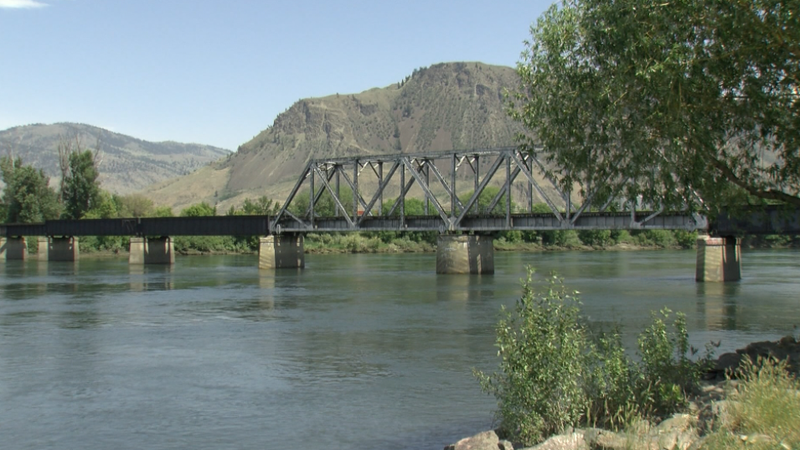
(Image Credit: CFJC News)
drought concerns

Kamloops drought concerns rise as river level drops

Jun 27, 2023 | 5:02 PM

KAMLOOPS– The North and South Thompson Rivers are seeing historic lows for this time of year and with a dry, hot summer still ahead of us, river experts are expecting a drought.

For many, those drought conditions would mean no slip-and-slides, car washing or unnecessary water use in the city. However, for those whose water use is for an agricultural purpose, it’s much more than that.

“It would be catastrophic, actually, because the only other option I would have is to hook hoses up to my domestic water supply and actually have somebody full-time walking along and hand-watering every plant that is out here,” Dieter Dudy, owner of Thistle Farm told CFJC News.


Dudy has been irrigating with water from the North Thompson for years. This is the first year he’s seen the water level so low. Currently, it’s just four centimetres above the level needed to pump water to his crops.

But after a dry, hot May, much of the snowpack feeding the river has melted and the chance of it rising before the end of the season is slim.

“Right now, things are a bit more like they would be in August, normally,” the Head of the River Forecast Centre, Dave Campbell, explained. “The big concern is, by the time we get into August, we are going to be in a significantly more challenging situation in terms of streamflow. “

Without water from the North Thompson, Thistle and many other farms in the area will be in danger of failing.

“It would be costly to the extent that that’s metered water that’s coming from our water treatment plant that I’m putting on irrigation — which is totally unnecessary,” Dudy said. “Either that or it dies and I’ve lost a whole season and my revenue and my livelihood.”

The City of Kamloops is also worried about conserving water and is forming a drought response team to monitor the situation, possibly restricting water use in the city.

According to Greg Wightman, utility services manager for the City of Kamloops, other municipalities in the region often limit irrigation to specific days during a drought, but because Kamloops’ water system is too complex, the city is looking at other options.

Wightman said things like aesthetic cleaning and pressure washings may be limited at earlier stages, and if we reach a Level Five drought, irrigation could be banned altogether. Currently, the Thompson Rivers are at Level Two.

“We are also going to be looking for a 25 per cent water reduction at city parks and city fields,” he said. “That’s something that we will be doing at earlier stages just trying to conserve as much water as possible. We are conserving for the potable water supply, but also for the ecosystem — particularly the salmon.”

Over the last year, the region has suffered a lack of precipitation. Campbell believes it’s unlikely Kamloops will get enough rain over the summer to make up for it.

“We are expecting to see stream flows to continue to worsen in terms of conditions and really we need to see significant rainfall through the summer to alleviate us from a drought late in the summer,” Campbell said.