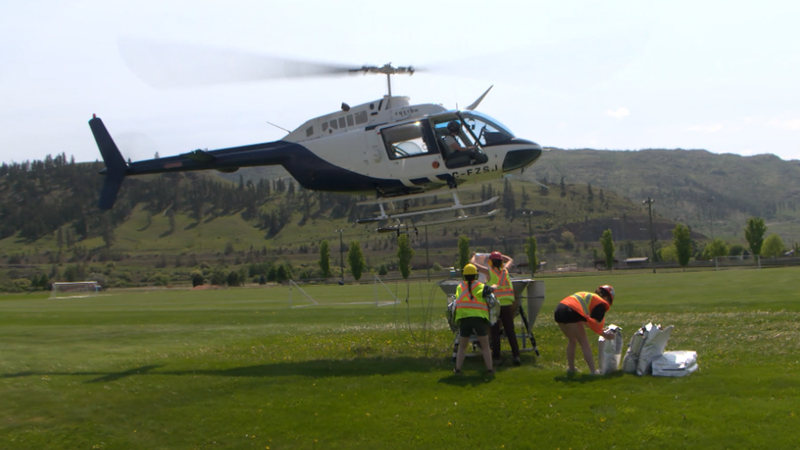
BWP Consulting employees filling helicopter spreader with corn granules. (Image Credit: CFJC News)
Mosquito control

Experts say Kamloops area may see fewer mosquitoes than usual this year

May 17, 2023 | 4:18 PM

KAMLOOPS – Mosquitoes are out and about a little earlier this year and with the recent warmer temperatures, the larvae have been developing especially fast. But with a normal-to-lower water level this year, BWP Consulting, a local mosquito control company, says we may see fewer of those pesky bloodsuckers this summer.

To treat large areas of mosquito larvae, BWP Consulting uses a helicopter to scatter granules of corn coated with BTI, a bacteria that kills mosquito larvae.

“It’s natural, it’s a naturally-occurring bacteria so we are not generating it, and it only targets mosquito larvae,” Chelsey Fischer, a mosquito control technician with BWP Consulting, told CFJC News. “There is no negative impacts to other creatures that eat it. It only impacts the mosquito larvae.”

This year, BWP Consulting is starting its helicopter campaign early because of an earlier rise in flood waters.

“It’s important because when the flood waters come up, all the mosquito eggs that are laid in the grass over the years, they get wet and they hatch, so we have a lot of eggs that have hatched all at once into larvae,” Fischer said. “Now we are treating them with a helicopter to treat a large area so that we can catch all these guys before they hatch into actual live mosquitoes.”

Mosquito eggs laid in the grass can survive up to 30 years, just waiting for the water levels to rise and wet them. Because this year’s water levels are expected to remain normal to lower, Fischer believes fewer bloodsuckers will be biting.

“If this a successful campaign, we should see fewer mosquitos than we would in previous years,” she said.

According to Ficsher, these floodwater larvae currently being treated are known as the nuisance species and are primarily responsible for human mosquito bites.

“As the waters recede and we are left with standing water, we do end up getting species that lay their eggs on the water, and those are the species that go toward birds and our other mammals,” she explained.

These species are known to carry West Nile virus and can be harmful to wildlife.

Fischer encourages property owners with standing water to contact the mosquito advisory line at (250) 372-5700.

BWP Consulting will be treating about 450 areas within the TNRD for mosquito larvae. For those still concerned about being bitten, Fischer suggests wearing long clothing and using a bug repellent containing DEET.