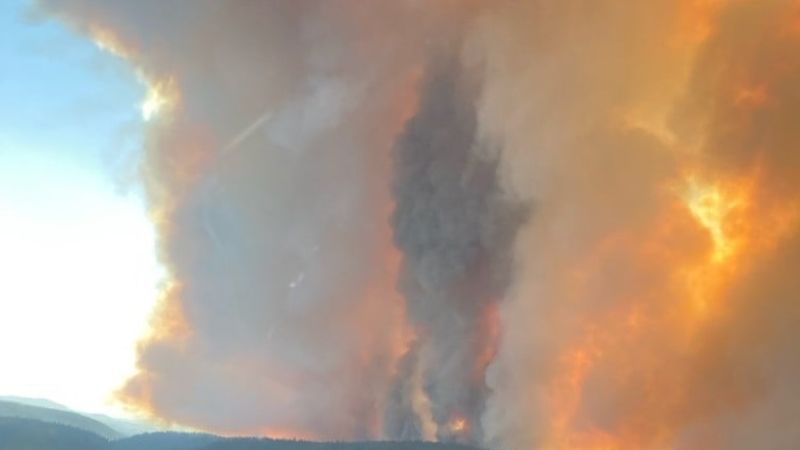
Image Credit: BC Wildfire Service / White Rock Lake wildfire / July 25/21
wildfire

Weather conditions could lead to more growth of White Rock Lake wildfire

Aug 4, 2021 | 2:57 PM

KAMLOOPS – Mother Nature is making it more difficult to fight the White Rock Lake wildfire southeast of Kamloops.

The fire has led to Evacuation Orders and Alerts within the Thompson-Nicola Regional District, the Columbia-Shuswap Regional District, the Regional District of North Okanagan, and the Okanagan Indian Band.

The wildfire had grown to over 32,000 hectares by Wednesday morning (Aug. 4) and is threatening to grow further with weather conditions that will favour fire activity.

“We are expecting a stable day today but increased fire behaviour activity as we get increased drying,” said White Rock Lake wildfire Incident Commander Scott Rennick. “Rain from three days ago had very little effect. We are seeing increased activity with clean air and convective activity.”

The BC Wildfire Service (BCWS) says it is building up its capacity to protect homes and structures being threatened. Fire Information Officer Hannah Swift says officials have assessed the communities of Westwold, Falkland, Cedar Hills, and communities along the Westside Road and are prepared to defend them from fire.

“The structure protection branch has ramped up and now consists of 117 structure protection personnel, three structure protection units, 17 fire engines, five mass water delivery systems and 14 water tenders,” Swift said.

Heavy smoke had restricted the ability of wildfire crews from attacking the blaze from the air. However, visibility has improved today.

“In the east flank, which is where we are seeing the most activity right now, we are using heavy lift helicopters and bucketing supporting, potentially skimmer (planes) and fixed wing retardant to slow the progression of the fire,” said Rennick.

The BCWS says crews along the southern flank are continuing work along Beautiful Road to mop up the excursion south of the Salmon River Forest Service Road, east of Salmon Lake. Where conditions permit, crews are completing small hand ignitions to burn off areas safely.

“We’re potentially looking at aerial and ground ignition operations to make that area safer and bring it back to operable conditions so we can actually fight the fire on our terms,” said Rennick.

On the western flank of the fire, the BCWS says it’s been successful in its work to control growth.

There are more than 130 firefighters on the ground fighting the blaze, including 99 from Quebec. They’re joined by 11 helicopters and 43 pieces of heavy equipment.